An advertising print featuring New York and Chicago baseball players estimated at €80-100 sold for a hammer price of €17,500 at Sheppards in Durrow today. The print, for E and J Burke Finest Pale Ales and Extra Foreign Stout depicted the two players drinking companionably, one with ale from a barrell, the other with stout.
The brothers Edward (1827?-1887) and John Burke (1829-1892) were Irish distillers, brewers, bottlers and importers, cousins of Benjamin Lee Guinness and grandsons of the first Arthur Guinness. The company they founded in. 1847 was in business in New York City from 1874 to 1953. A six story brick warehouse at 616 W 46th St. served as headquarters and storage from 1913-1922.
A Chinese Qing hardwood and silk throne screen with six embroidered panels made €42,000 at hammer. It had been estimated at €30,000-60,000.
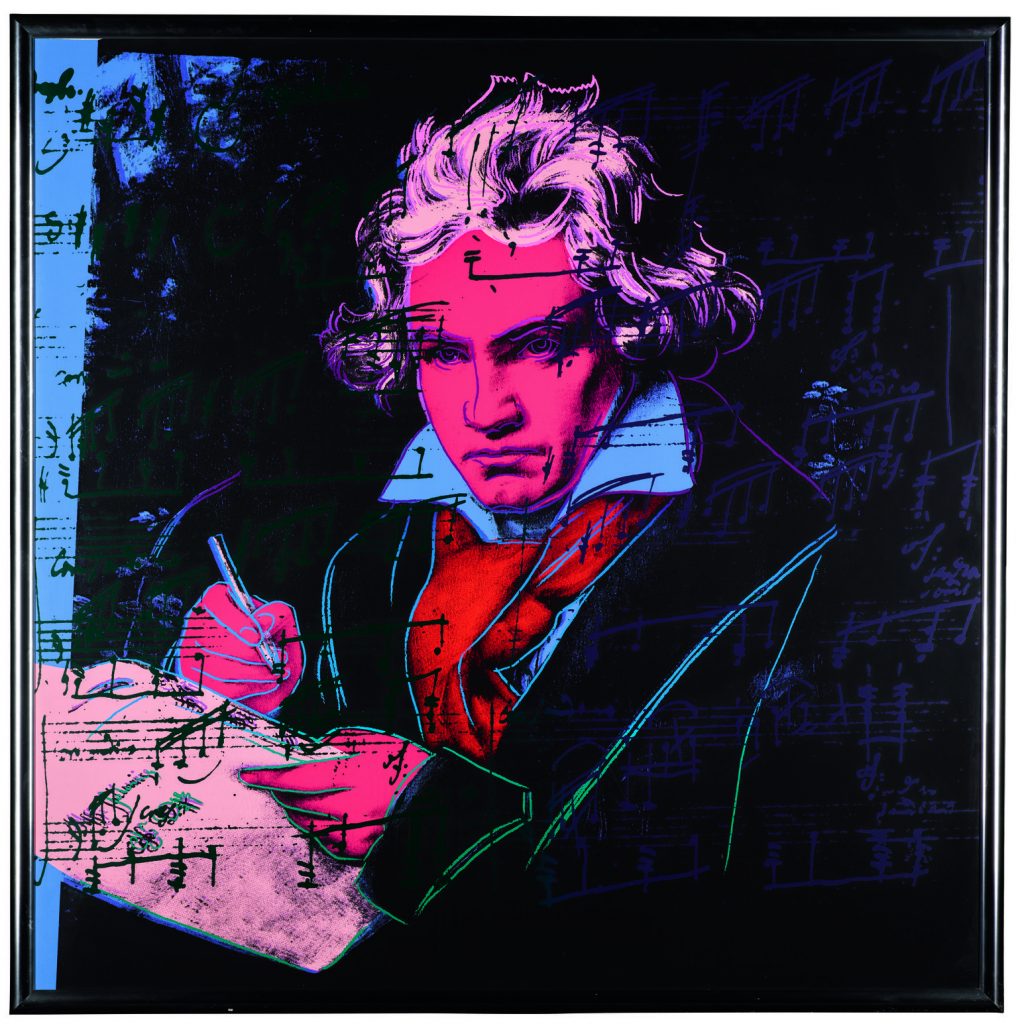
A rare complete set of Beethoven screenprints by Andy Warhol comes up at Sotheby’s sale of prints and multiples in London on March 19. This year marks the 250th anniversary of Beethoven’s birth. Warhol spared no effort in transforming the idealised and iconic portrait of the composer by Karl Stieler, into the rock star persona portrayed within this set of four screenprints. Created shortly before Warhol’s death in 1987 they are estimated at £200,000-300,000.
A foiled armed Belfast bank raid in 1974 is recalled in a lot to come under the hammer at Dix Noonan Webb in London on March 4. A group of three Queen’s Gallantry Medals awarded to RUC Detective Constable James Patrick Hardy will be offered with an estimate of £4,000-5,000. He was one of two policemen who spotted the getaway car speeding away from a robbery at the Trustee Savings Bank at Glengormley in November 1974. Tbey gave chase and the getaway car crashed into the security fence at the Corr’s Corner Roadhouse.
A newspaper account quoting the second RUC man, Detective Sergeant George McMullen is included. Sgt. McMullen said: “When the car stopped four armed men got out and we ordered them to halt. After repeated warnings we drew our pistols and opened fire, hitting and wounding one man. He and one of the others stopped and after a further chase we caught all four.” More than £1,800 in cash was recovered and the robbers were subsequently brought to trial.
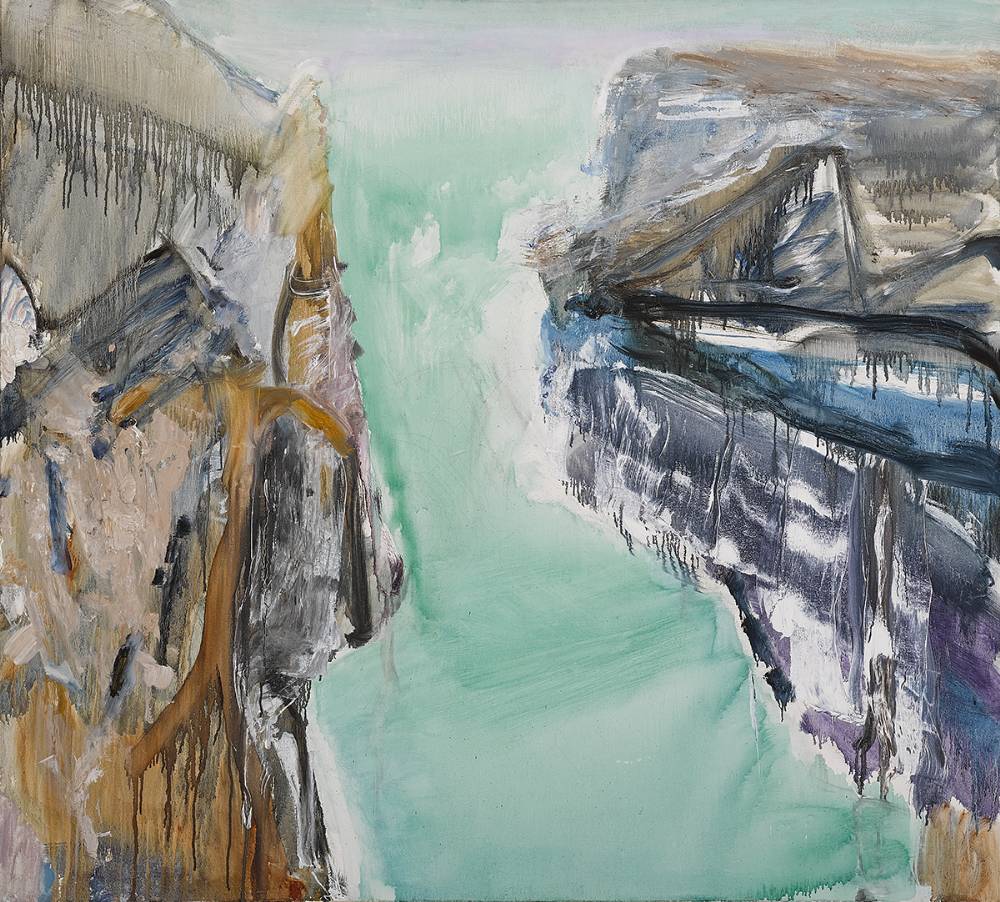
Art auctioneers Whyte’s, who enjoyed a record breaking year in 2019, will kick off their 2020 art selling season on March 9. The evening sale of Irish and International Art at the RDS in Dublin includes works by Yeats, Paul Henry, William Conor, Beatrice Glenavy, William Sadler, Nathaniel Hone the elder, Louis le Brocquy, Tony O’Malley, Donald Teskey, Barrie Cooke and many more. Whyte’s results in 2019 were aided in no small part by the record breaking November sale of the Ernie O’Malley Collection at which two works by Yeats soared past the million euro barrier. A 1948 Yeats, Rusty Gates, is the most expensively estimated lot in this upcoming sale with an estimate of €100,000-150,000. It depicts two elderly gentleman standing before a gateway in a high stone wall in a setting reminiscent of Co. Wicklow with a Sugar Loaf like mountain in the background.The first ROSC exhibition in Dublin at the RDS in 1967 was built around 50 of the “best” living artists at that time and included Francis Bacon, Willem de Kooning, Roy Lichtenstein, Joan Miro and Pablo Picasso. Among those exhibiting was Polish artist Tadeusz Brzozowski (1918-1987). His work Mastiff from that show returns to the RDS to go under the hammer as Lot 53 with an estimate of €80,000-100,000. The Bog Road by Paul Henry dates to 1917-1923 and is estimated at €50,000-70,000, Stage Girls by Daniel O’Neill is estimated at €30,000-50,000 and works by Sir John Lavery include two portraits and a painting of two cigarette girls in Seville in colourful costume. There is art by Gerard Dillon, Colin Middleton and George Campbell and Reclining Woman by Roderic O’Conor is estimated at €15,000-20,000. Large oils by John Shinnors and Donald Teskey, Sculptor’s Scarecrow and Coastal Report II are each estimated at €10,000-15,000, Mayo Summer by Tony O’Malley is estimated at €15,000-20,000, Rakaia Gorge I by Barrie Cooke is estimated at €6,000-8,000 as is an Aubusson tapestry from the 1970’s by Patrick Scott.The Embarkation of King George IV at Kingstown 1821 by William Sadler II is full of minute detail recording the historic visit to Ireland by the British monarch. The King arrived drunk and suspicions persisted that the main purpose of the trip was to visit his mistress, Lady Conyngham at Slane Castle. The visit was presented as a success and Lot 98 is estimated at €12,000-18,000.There are 200 lots on the catalogue, which is online.
Rakaia Gorge I by Barrie Cooke UPDATE: THIS WAS UNSOLD
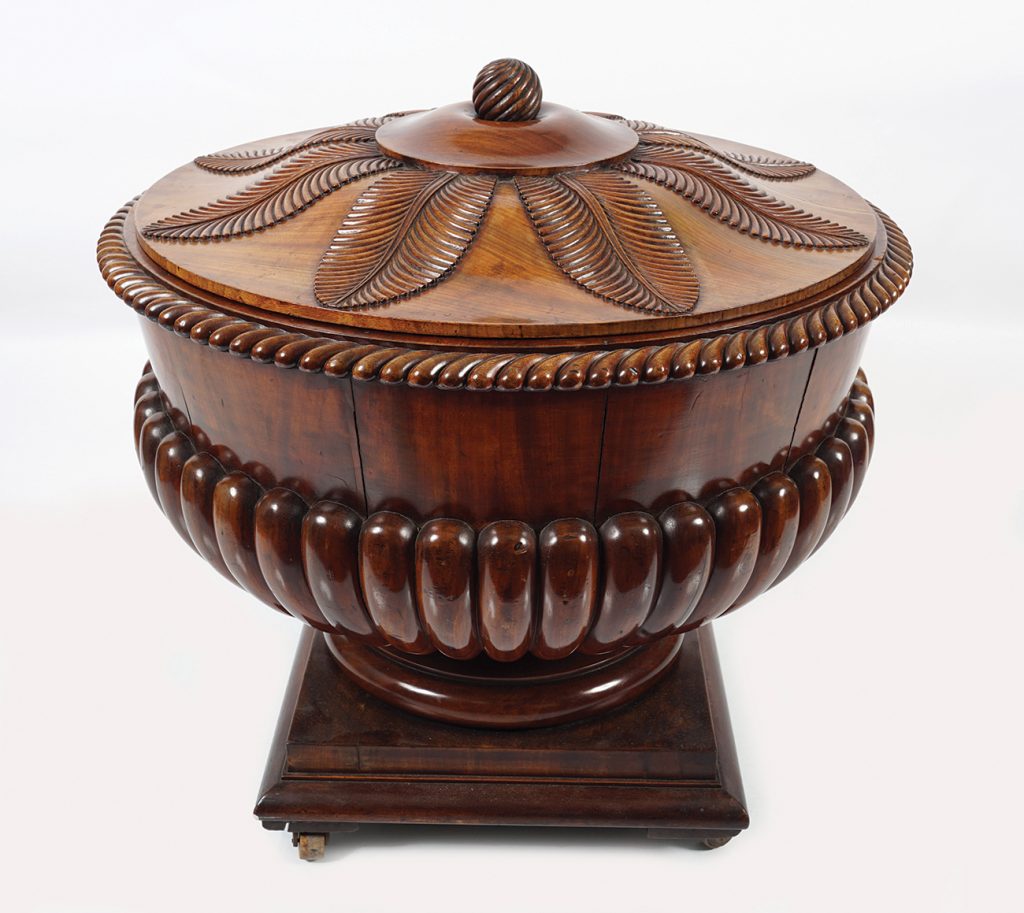
One of the most rewarding aspects of a love of antiques is that there is always something new. Lot 556 at Sheppards three days sale in Durrow on March 3, 4 and 5 is a case in point. Among the lots on offer is a large and unusual c1830 Irish circular sarcophagus form carved mahogany wine cooler. Attributed to the Dublin firm of Williams and Gibton it comes with an acanthus leaf carved lid which opens to a lead lined interior. Rarity comes with a price, unfortunately, and this one is estimated at €15,000-25,000. Viewing at Sheppards is now underway.
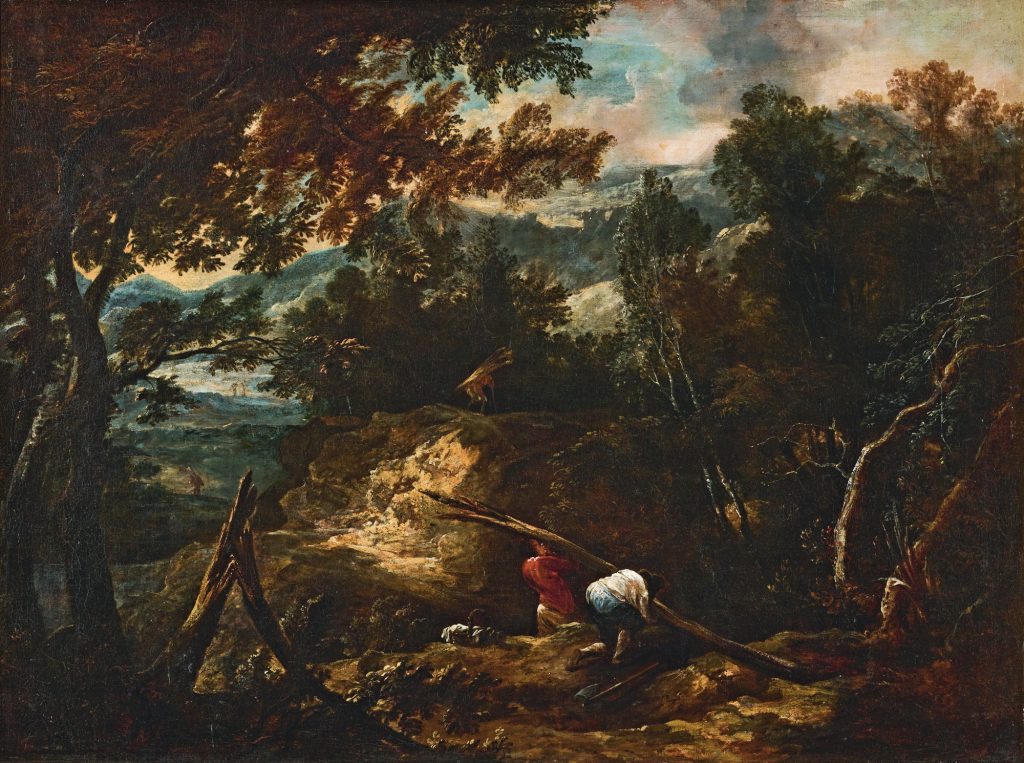
A Mountainous Wooded Landscape with figures gathering wood by Cork artist John Butts comes up at Sotheby’s sale of 44 Fitzwilliam Square, works from the estate of the late Patrick Kelly in London on March 18. It is estimated at £20,000-30,000. The talented artist, who died aged only 37 in 1764, worked as a teacher in Cork where his pupils included James Barry and Nathanial Grogan. He moved to Dublin around 1757 and worked predominantly as a scene painter. A comparable painting by the artist, Poachers: View in the Dargle, is at Tate Britain. In a letter written after his death James Barry described him as … “an unfortunate man, who with all his merit never met with any thing but cares and misery, which I may say hunted him into the very grave. His cast of genius was very much that of Claude’s, whom he resembles without any imitation more than anybody that I know of”. His View of Cork is one of the most popular works in the collection of the Crawford Gallery.
JOHN BUTTS – A Mountainous Wooded Landscape with figures gathering wood
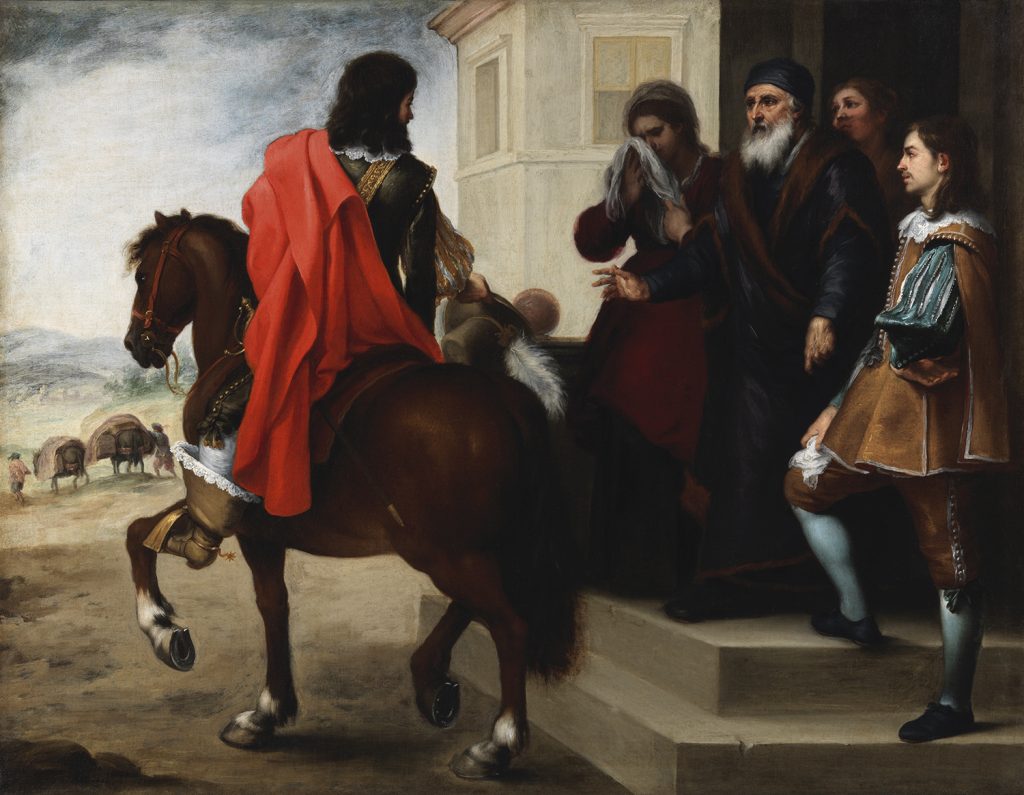
Murillo: The Prodigal Son Restored which opens at the National Gallery of Ireland on February 29, follows a long conservation project. It is 30 years since Murillo’s series of paintings based on the parable of the Prodigal Son has been on display here.
The Prodigal Son cycle by Bartolomé Esteban Murillo explores sin, repentance and forgiveness across six paintings, staged in seventeenth-century Seville. It is the only intact narrative cycle by Murillo in the world. Donated by the Beit family in 1987, the works have been conserved at the Gallery’s Paintings Conservation Studio in a project led by Muirne Lydon, who remarked: “The conclusions of technical research performed on the paintings during conservation will be highlighted in the exhibition, revealing how the series was created – from canvas to ground layers and pigments – and the transformations that they have gone through over time. This new research adds to the growing body of knowledge of Murillo’s painting technique and materials. By situating the paintings both culturally and technically, the exhibition hopes to demonstrate that it is crucial to understand these masterpieces beyond their surface, thereby allowing our visitors to fully appreciate this exceptionally rich series.”
Sean Rainbird, Gallery Director said: “Murillo’s Prodigal Son cycle is one of the treasures of the collection of the National Gallery of Ireland. We are delighted that this exceptional group of paintings, now gloriously conserved for future generations, will be on view at the Gallery this Spring.” The exhibition continues until August 30.
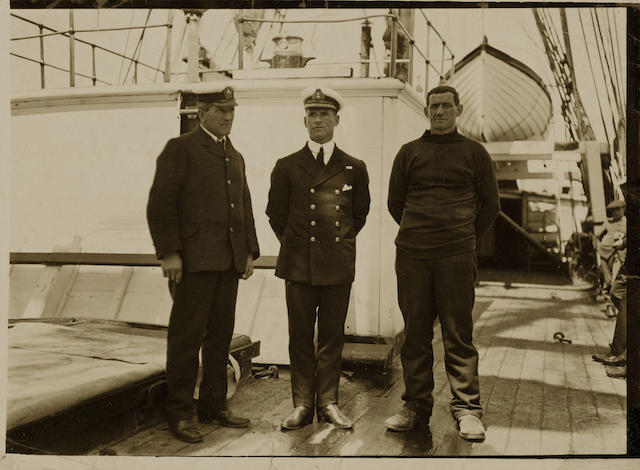
This 1912 group portrait of on deck of the Terra Nova with Irish Antarctic explorer Tom Crean, Lieutenant E.R.G.R. “Teddy” Evans and William Lashly, made £5,300 over a top estimate of £800 at Bonhams Travel and Exploration sale in London. The three had formed the last of the supporting teams to be sent back by Scott, as he commenced the final push for the South Pole. During the return journey Evans went down with scurvy, and tried to persuade Crean and Lashly to leave him behind. Instead they strapped him to a sledge and man-hauled him to within four or five days’ march of Hut Point. From there Crean set out to collect help, while Lashly stayed to look after Evans. Evans’ saviours were both awarded the Albert Medal.
Tom Crean (1877-1938) was a member of three Antarctic expeditions. He joined Robert Scott’s Discovery Expedition of 1901-04. After Terra Nova his third and final expedition was as second officer on Ernest Shackleton’s Imperial Trans Antarctic Expedition. After the ship Endurance became beset in the pack ice and sank, Crean and the ship’s company spent 492 days drifting on the ice before a journey in boats to Elephant Island. He was a member of the crew which made a small boat journey of 800 nautical miles from Elephant Island to South Georgia to seek aid.
(See post on antiquesandartireland.com for February 19, 2020)
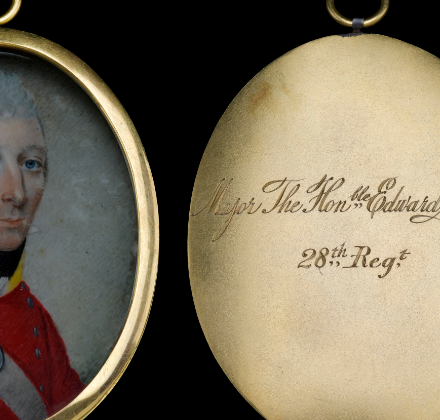
The Small Army Gold Medal for Orthes 1814 awarded to Major the Hon. Edward Mullens, 28th Foot comes up at Dix Noonan Webb in London on March 5. Mullens was the fifth son of Sir Thomas Mullens, 1st Baron Ventry. Frederick William Mullens (d. 1712), an English Colonel who claimed descent from the Norman de Moleyns, established this branch of the family in Co. Kerry, settling at Burnham House near Dingle around 1666. His great-grandson, Sir Thomas Mullens (1736-1824), one of three major electoral patrons in Kerry, was created Baron Ventry in the Irish peerage on July 31, 1800, as a reward for his family’s support for the Union with Britain and the abolition of the Irish Parliament.
In the Napoleonic Wars Edward Mullens fought in fifteen battles in the Peninsula between 1809 and 1814, commanded a Light Battalion at Orthes, and was one of the heroes of the Battle of Barossa. At the battle of Orthes on February 27, 1814, Mullens commanded a brigaded battalion made up of all the Light Companies of Colonel O’Callaghan’s Brigade, those of the 28th, 34th, and 39th Foot, plus a Company of 5th Battalion 60th Rifles. His mission, successfully accomplished, was to seize and hold the ford over the Gave de Pau river at Souars.
His Field Officer’s Gold Medal is fitted with three-pronged gold ribbon bar together with a fine colour portrait miniature of the recipient on ivory, in a silver-gilt and gilt metal glazed oval frame, the reverse engraved ‘Major The Honble Edward Mullens. 28th Regt.’ It is estimated at £18,000-22,000.
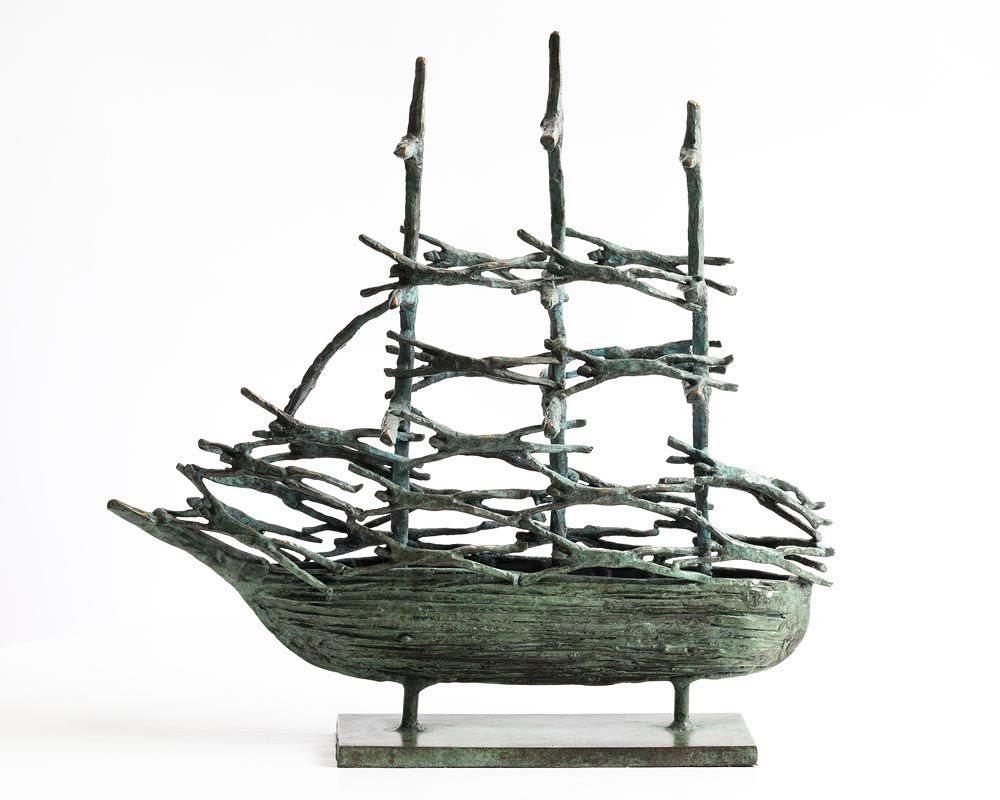
AN online sale of Irish art by Morgan O’Driscoll runs to Monday March 2. There is paintings and sculpture from artists like John Behan, John Shinnors, George Campbell, Elizabeth le Jeune, Patrick O’Reilly, James Humbert Craig, Mark O’Neill, George Campbell and many more. The catalogue is online.
John Behan – Westport Famine Ship (2018) 5,000-7,000 . UPDATE: THIS MADE 6,200 AT HAMMER