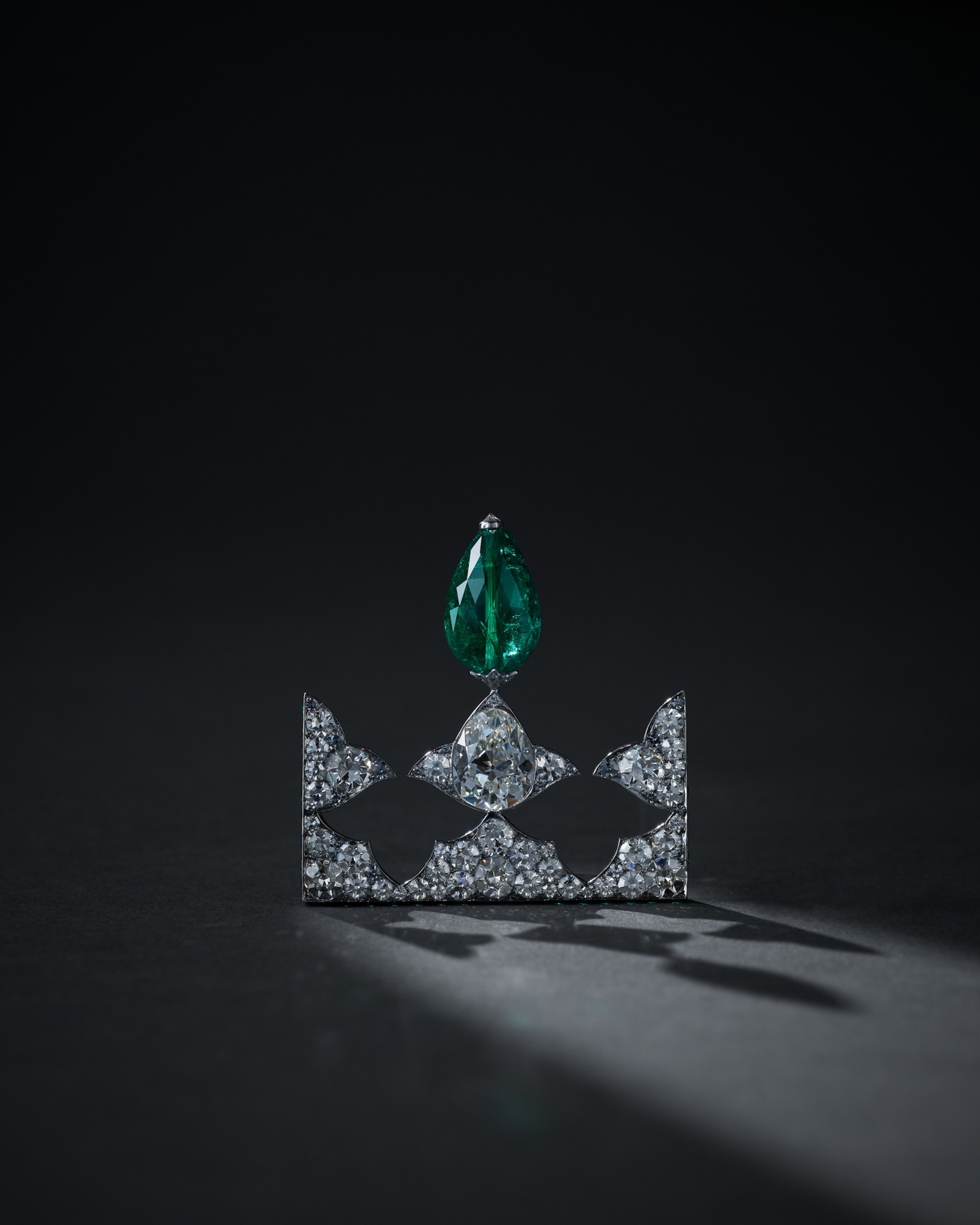
Inspired by Mughal architecture this brooch is designed as a jewelled ‘fragment’. It features an Old-European cut diamond weighing 4.82 carats surmounted by a faceted Colombian Emerald drop weighing 9.77 carats. The brooch is mounted in Platinum, signed BHAGAT. This Fragment Brooch by BHAGAT Diamonds of Mumbai is now on display at TEFAF online.
BHAGAT produces fewer than 60 pieces a year and works with a strictly limited but opulent palette of precious gemstones, often rare and important stones in vintage cuts, and platinum. The essence of BHAGAT’s originality lies in the manner in which classical Indian forms and motifs are united with a contemporary sensibility that, while it combines aspects of east and west, is entirely original. Now in its fourth and fifth generations, BHAGAT is run by Viren along with his two sons, Varun and Jay. In recent years their works have been displayed at The Kremlin State Museum in Moscow, The Metropolitan Museum of Art in New York, The Victoria & Albert Museum in London, The Miho Museum in Kyoto, The Grand Palais in Paris, The Palazzo Ducale in Venice and the Palace Museum in Beijing.
This 1798 hand coloured etching by the British caricaturist James Gillray is of Napoleon Buonaparte hearing of Nelson’s victory at the Battle of the Nile and swearing by his sword to extirpate the English from off the Earth. It comes up as a rather timely lot 9 at the Collector’s Cabinet sale by Mullen’s of Laurel Park, Bray on September 11 with an estimate of 200-300. A number of commemorative events and auctions are being held around the globe this year to mark the bicentenary of the death of Napoleon. The online sale at Mullens offers 546 varied lots militaria, historical memorabilia, 275 lots antiquarian books and modern books including signed first editions, sporting memorabilia and more. UPDATE: THIS ETCHING MADE 340 AT HAMMER
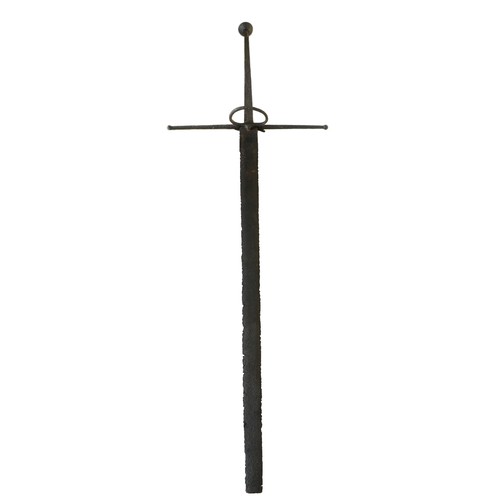
ONE of the most historic items at the Howth Castle sale, the great sword of Howth, made a hammer price of 40,000 at day two of Fonsie Mealy’s Howth Castle contents sale today. It has been estimated at 10,000-15,000. The auctioneer announced that it would be staying in Ireland. According to tradition, it was used by Sir Armoricus Tristram, who arrived at Howth with Sir John de Courcy in the year 1177. It has been in the St Lawrence family for many generations and a more sober assessment dates the sword to the late 15th century, so it may well have been borne by Sir Armoricus’s descendant Sir Nicholas St Lawrence, 16th Lord & 3rd Baron Howth. He commanded the “billmen” (wielders of a fearsome chopping blade mounted on a strong staff) at the battle of Knockdoe in 1504, in which the army of the Lord Deputy, the Earl of Kildare, defeated that of Ulick Burke, Lord of Clanricarde. The Sword is first recorded in an inventory of 1748.
Again on the second day of the sale at Howth Castle there was competitive bidding from Ireland and abroad for once off items of rarity. A George IV silver gilt model of the Warwick Vase by Philip Rundell, London, 1820 made 24,000 at hammer and an Irish William IV silver gilt Warwick Vase by Richard Sawyer junior Dublin 1836 made 23,000. Each had been estimated at 8,000-12,000. An Irish George II silver salver by John Hamilton, Dublin 1726-27 made 21,000 over a top estimate of 7,000. A jewel cut breast star of The Most Illustrious Order of St. Patrick together with a small ceremonial sword made 32,000 at hammer over a top estimate of 10,000. William Ulick Tristram St. Lawrence, 4th Earl of Howth (1827-1909) was appointed knight of the order in May 1884.
EMERALD AND DIAMOND BRACELET, CIRCA 1945. UPDATE: THIS MADE €30,000 AT HAMMER
THIS c1945 em emerald and diamond bracelet is one of the highlights at Adams evening and online sale of fine jewellery and watches in Dublin on September 14. The geometric open work design bracelet with graduated cabochon emeralds is estimated at 30,000-40,000. There is a similar estimate on a pair of fancy coloured diamond and pendant earrings. With everything from a c1960 bow diamond brooch by Bulgari (18,000-28,000) to a tri coloured trinity gold ring by Cartier (800-1,000) the sale of 102 lots caters for a variety of budgets. The catalogue is online.
Fonsie Mealy’s Howth Castle sale got off to a flying start today as collectors vied for blue a white and coloured Oriental porcelains. A 17th/early 18th century baluster vase and cover made 14,000 at hammer over a top estimate of 3,000. It has a six character mark to the base and is decorated with Royal subjects and attendants. Am 18th century Kangxi blue and white Gu vase with a top estimate of 3,000 made 12,000 on the hammer. An 18th century Famille Rose baluster shaped vase and cover with a top estimate of 1,800 made 4,800 on the hammer. A pair of Nankin blue and white platters with a set of three similar smaller dishes made 1,300 over a top estimate of 450 and two Xiangshi period triple gourd blue and white cafe au lait vases made 3,200 over a top estimate of 1,500. An 18th century blue and white jar and cover decorated with children at play made 7,500 over a top estimate of 1,000 and a large Chinese bronze gilt figure of a Buddha with a top estimate of 1,100 made 2,500. A large Majolica Palissy type oval dish made 8,600 at hammer over a top estimate of 350 and an 18th century bronze incense burner in the shape of a Foo dog with a top estimate of 600 made 5,000 on the hammer.
The latest in the series of collectibles auctions at Mullen’s includes historical memorabilia, rare and antiquarian books, militaria, arms and armour and sporting memorabilia. The live and online auction, which takes place on September 11, offers a variety of collectibles from a 1913-16 Irish Volunteers captains tunic to 24 mostly signed books by the Nobel Prize winning poet Seamus Heaney. There are 55i lots in total.
AN IRISH VOLUNTEER 1913-1916 TUNIC. UPDATE: THIS MADE 4,000 AT HAMMER
This presentation copy of Dubliners signed by James Joyce is among the highlights of The Exceptional Literature Collection of Theodore B. Baum, to be sold in two parts at Christie’s in New York this month. It is estimated at $150,000-250,000. Inscribed copies of Dubliners are very rare and only three have been recorded at auction in the past 80 years. This one is the only example still in its original dust jacket. It is inscribed by Joyce to his publisher Crosby Gaige: “To Crosby Gaige James Joyce Paris 25.V.28.” This inscription dates to just five months after Gaige published Anna Livia Plurabelle, a section of Finnegans Wake, in a signed limited edition of 850 copies.
On November 28, 1905 Joyce mailed the manuscript of Dubliners to Grant Richards, who accepted it for publication in February 1906 and announced it the following month in The First Catalogue of Books Published by Grant Richards. In April, however, objections from the printer halted production. Joyce wrote an angry letter to Richards on 5 May: “You tell me in conclusion that I am endangering my future and your reputation. I have shown you earlier in the letter the frivolity of the printer’s objections and I do not see how the publication of Dubliners as it now stands in manuscript could possibly be considered an outrage on public morality…” (Herbert Gorman, James Joyce, pp.149). Although Joyce agreed to a few alterations, Richards soon abandoned his plans for Dubliners. Joyce offered the book to others, including Elkin Mathews and George Roberts at Maunsel. Maunsel printed an edition of 1,000 copies by July 1910 but this was destroyed by the printers because of objectionable passages. At the most, only a few sets of page proofs of this edition were retained by Joyce.
Joyce returned to Richards on 23 November 1914, committed to publishing the book as it was written, which by then had grown by two stories, “A Little Cloud” and “The Dead,” the masterpiece with which the collection concludes. Joyce guaranteed the sale of 130 copies in Trieste. Richards agreed, signed a contract on 4 March 1914 and published the book on 15 June. 1,250 sets of sheets were printed, of which approximately 746 were bound in this edition. The remaining 504 sets were sold by Huebsch in New York.
Mr. Baum’s library of literary first editions is among the finest ever assembled, built over the course of decades as he worked closely with top dealers and auction houses to locate the best copies of the most beloved books. The collection is particularly strong in works by English and American authors—from Edmund Spencer and John Milton in the 16th & 17th centuries through Jonathan Swift, Jane Austen, Charlotte Brontë, and Charles Dickens in the 18th & 19th centuries, all the way to Kurt Vonnegut, Toni Morrison and more in the 20th century.
The live online sale is on September 14. Part II of the online auction runs from September 2-17.
UPDATE: The Exceptional Literature Collection of Theodore B. Baum, sold across two live and online sales, totalled $9,657,875, surpassing the pre-sale high estimate.
There is water everywhere in William Roe’s 1837/38 views of Cork which come up as lot 17 at Mullens Collectors Cabinet online sale on September 11. Much of the city as we know it today is built on reclaimed land. The lot consists of seven framed sheets each with between two and four views of Cork city and environs. It is estimated at €2,000-€3,000. Works by Roe were displayed at the Cork Exhibition of 1852. UPDATE: THIS MADE 2,000 AT HAMMER
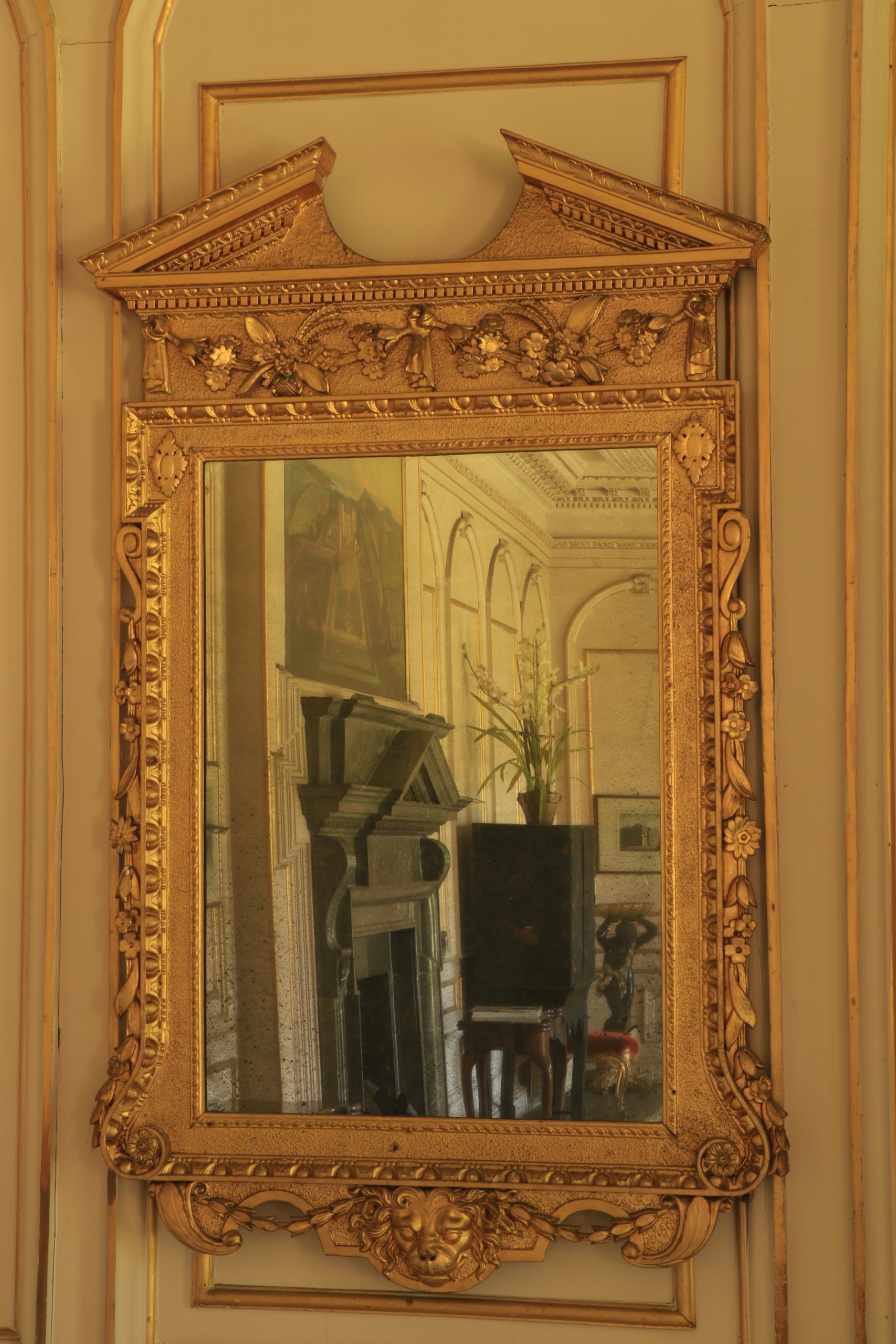
One of a pair of George II architectural pier mirrors by John Booker UPDATE: THE PAIR SOLD FOR 106,000 AT HAMMER
From Booker mirrors to an original portrait of Jonathan Swift to a clock garniture gift from Marie-Antoinette and a pair of commodes attributed to James Hicks the Howth Castle sale by Fonsie Mealy next week promises to be a humdinger. This auction of 800 years of history for the Gaisford-St. Lawrence family and other important clients offers an appetising variety of antique furniture, art, ceramics, glass and all sorts of historic collectibles like a painted wooden model of HMS Victory, an 18th century Irish School relief of the legend of Grainne Uaile, a mourning dress worn by Queen Victoria and the Great Sword of Howth which has been in the St. Lawrence family for many generations. According to tradition, the sword was used by Sir Armoricus Tristram, who arrived at Howth with Sir John de Courcy in the year 1177 and commanded the Norman army which defeated the local inhabitants. A more sober assessment dates the sword to the late 15th century. It is estimated at €10,000-€15,000. The live and online auction will take place at the Grand Hotel, Malahide on September 8 and 9 with admission subject to prevailing Covid conditions. The most expensively estimated lot, at €300,000-€400,000, is a unique full length portrait of Jonathan Swift painted in 1735 by Francis Bindon (1690-1765). There is an estimate of €50,000-€70,000 on Bull by Moonlight by Roderic O’Conor and A Birds Eye View of Howth Castle attributed to William Van Der Hagen or Joseph Tudor is estimated at €40,000-€60,000.. There are several Bruxelles and Flemish tapestries and an impressive set of prehistoric Giant Irish Elk antlers and skull.
This Louis XVI French mantle clock by Regnault of Paris together with two candlesticks was a gift from Marie Antoinette to her lady in waiting Marie Therese de Barmont. UPDATE: THIS MADE 28,000 AT HAMMER.
Among a number of lots certain to attract international interest is a pair of Irish George II carved giltwood and gesso architectural mirrors attributed to John Booker. These are estimated at €50,000-€70,000. A c1738 pair of Irish giltwood and gesso carved side tables believed to have been supplied to the 14th Lord Howth come with an estimate of €30,000-€50,000.A pair of satinwood and bow fronted commodes attributed to James Hicks are estimated at €7,000-€9,000 and a mid 18th century Irish side table is estimated at €8,000-€12,000. A magnificent Georgian mahogany dining table (€30,000-€40,000), a mid 18th century Irish mahogany decanter stand (€20,000-€30,000) and a Gothic Revival side table or alter attributed to Pugin (€4,000-€6,000) are among other remarkable furniture lots.A Louis XVI French ormolu mantel clock by Regnault of Paris with two matching candlesticks was a gift from Marie Antoinette to her lady in waiting Marie Therese de Barmont. Marie Antoinette was 14 at the time of her wedding in 1770, Marie Therese de Barmont was 13. The set is estimated at €4,000-€6,000.
A mid 18th century Irish mahogany decanter stand. UPDATE: THIS MADE 48,000 AT HAMMER
There is silver and plate, militaria, ceramics, porcelain, glassware and some estimates are as low as €80. With more than 970 lots on the catalogue and this truly a sale with something for everyone. Lot 787 is a George IV silver gilt model of the Warwick Vase by Phillip Rundell, London 1820 (€8,000-€12,000), there are early Netherlandish School portraits of the Bishop of Meath George Montgomery and his wife Susan Steyning (€10,000-€15,000) and an early 19th century Cantonese bowl and cover is ex the collection of the O’Briens at Dromoland Castle with an estimate of just €180-€220.The clearance sale of Howth Castle will continue with the sale of the library on September 22 and 23. The castle has been home to the St. Lawrence family since the Norman Invasion. Since 1919 it has been held by the distraff heirs, the Gaisford-St. Lawrences. In 2018 the family agreed to sell the castle, demesne and Ireland’s Eye to the Tetrarch investment group who intend to develop a hotel and a luxury resort. A seven acre portion has been sold to Glenveagh Homes who plan to build 200 apartments.
(See posts on antiquesandartireland.com for August 12, 23 and 31)
The most valuable Einstein manuscript ever offered at auction comes up at the Exceptional Sale at Christie’s in Paris on November 23. The 54-page autograph manuscript written by Albert Einstein and Michele Besso between June 1913 and early 1914 documents a crucial stage in the development of the theory of general relativity. This theory re-shaped modern understanding of how the universe works. It is estimated at €2,000,000-3,000,000).
The manuscript is also a particularly valuable record of Einstein’s relationship with Michele Besso, the Swiss engineer who was his collaborator, confidant, and lifelong friend.
Adrien Legendre, Director of the Books and Manuscripts department, commented: “We are delighted that Christie’s will be able to promote this extraordinary manuscript to its international network of collectors for our Exceptional Sale. Einstein’s autographs from this period, and more generally from before 1919, are extremely rare. As one of only two surviving manuscripts documenting the genesis of the General Theory (along with the so-called Zurich notebook from late 1912/early 1913 – now in the Einstein Archive at the Hebrew University in Jerusalem), it provides a remarkable insight into Einstein’s work and a fascinating dive into the mind of the greatest scientist of the 20th century.