Victorian Cast Iron Spiral Staircase. UPDATE: THIS MADE 320 AT HAMMER
This Victorian cast iron spiral staircase (€400-€800) is among the feature lots at Gormley’s online sale of the collection of Arthur Livingstone of Cuiltybar House, Coolaney, Co. Sligo and other clients on June 17 and 18. The top lot is a 1971 Citroen DS21 with rare right hand drive and refurbished interior (€40,000-€45,000). The sale is now on view at Coolaney. A total of 850 lots including vintage cars, pocket watches, walking sticks, clocks, scientific instruments, books, furniture and art will come under the hammer. The catalogue is online.
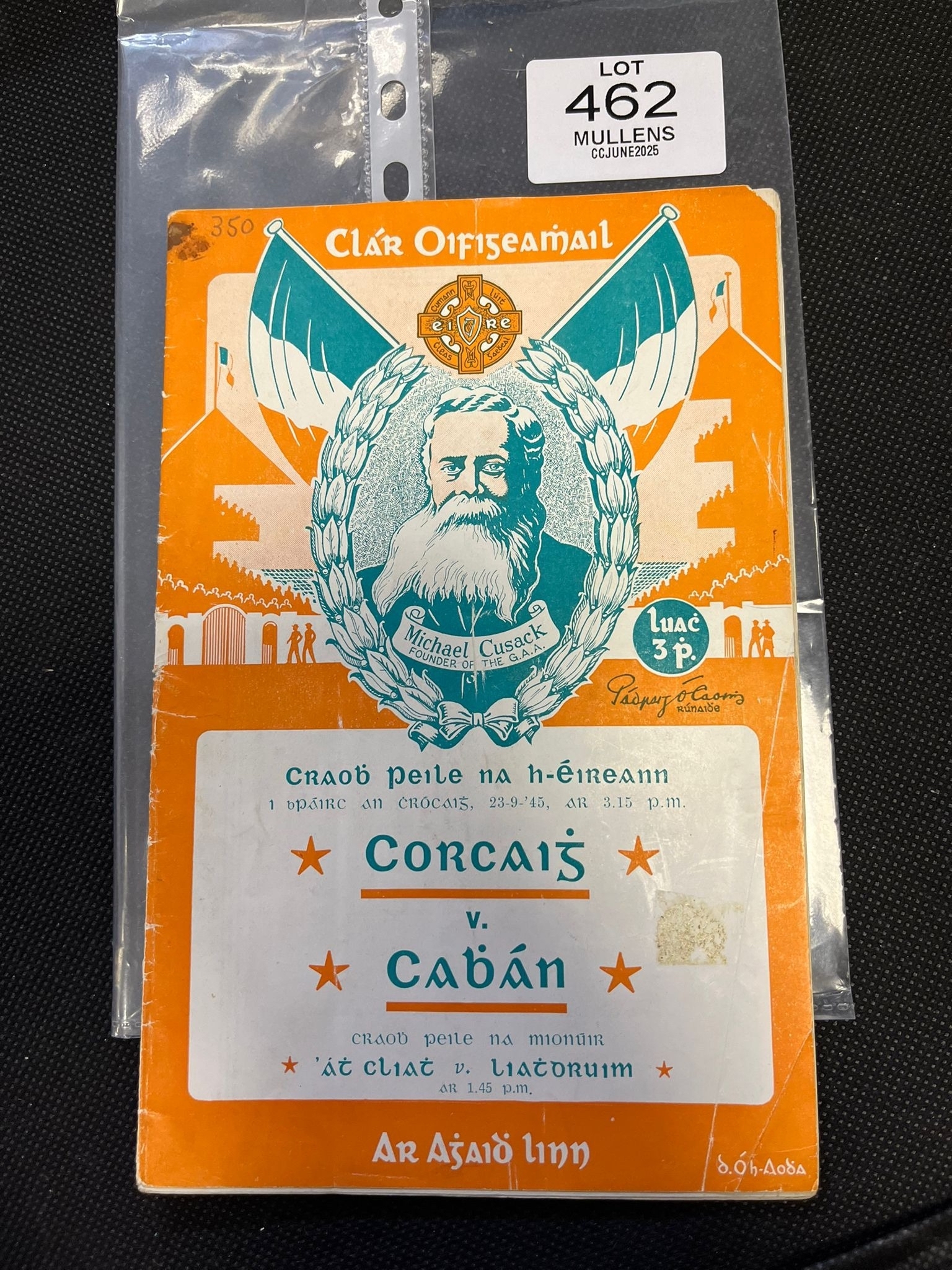
A 1945 All-Ireland senior football progamme is among the lots at The Collector’s Cabinet timed online auction by Mullen’s of Laurel Park, Bray, which runs until June 21. Outsiders Cork beat Cavan on a scoreline of 2-5 to 0-7. In this historic game the former Taoiseach Jack Lynch became a dual All-Ireland medallist. He had won four successive All-Ireland senior hurling medals between 1941 and 1944. The estimate for the programme is €400-€600.
A 19th century French gold brocade royal blue carriage bag owned by Queen Maria Amelia, the last Queen of France. UPDATE: THIS MADE 1,200 AT HAMMER
With a range that spans everything from fossilised Irish elk horns to Oscar Wilde’s desk, a landscape attributed to John Butts and a handbag owned by the last Queen of France heritage, history, beauty and rarity are not in short supply at Fonsie Mealy’s summer fine art and antique sale in Castlecomer on June 18 and 19.
Among many highlights are a pair of 19th century terrestrial and celestial globes on stands by John and William Newton, London 1818 (€15,000-€20,000), a Louis XV clock and matching barometer by Julian Le Roy, Paris (1686-1759) (€10,000-€15,000), a bronze of The Cossacks Crossing the Balkans by Evgeny Alexandrovich Lanceray (1848-1886) (€10,000-€15,000), a collection of 19th and early 20th century erotic Indian miniatures (€7,000-€10,000) and a four fold screen The Star of Bethlehem after Edward Burne-Jones (€4,000-€6,000).
Lots like these do not come cheap but this sale of fine art, antique furniture, silver, miniatures, decorative objects and religious artefacts sourced from private estates and collectors across Ireland offers a diverse collection to suit every taste and budget. Estimates are from €30 and €40 up for lots including a figure of Buddha and carved ebony elephants (€60-€80), a pair of Birmingham silver pillar candlesticks (€100-€150) and an Edwardian dinner gong with horn supports (€80-€120). More than 1,000 lots will come under the hammer.
The Irish giltwood side table and mirror by Arthur Jones, featured here last Saturday, is at €15,000-€20,000 among the most expensively estimated items.
The oversized slope front desk used by Oscar Wilde with, inset, a photo of the author, poet and playwright. UPDATE: THIS MADE 29,000 AT HAMMER
Fishermen by a River at Sunset attributed to John Butts (c1728-1765). UPDATE: THIS MADE 4,000 AT HAMMER
There will be literary interest in a large William IV slope top davenport attributed to Gillows with provenance to Oscar Wilde (€6,000-€8,000). Like many items at Wilde’s house at Tite St. in Chelsea it was quietly removed by friends who offered financial support and safeguarding of personal items before the court ordered auction of his possessions after his trial and imprisonment in 1895. The artist Mortimer Menpes, godfather to Wilde’s son Vyvyan, took this desk and a French bateau bed exhibited at the Paris World Fair in 1878. The bed, also in this sale, is estimated at €3,000-€4,000.
A c1740 oil on canvas of Fishermen on a River at Sunset is attributed to John Butts (€4,000-€6,000), the artist who started his career in Cork and was influenced by Claude Lorrain and Salvator Rosa. In a catalogue note Dr. Peter Murray explains that the attribution of this Claudean landscape to Butts is based both on the subject matter and the style of painting.
A 19th century French royal blue gold brocade carriage bag with coronet and trestle design was owned by the French Queen, Maria Amalia of Naples and Sicily (1782-1866) who was married to Louis Philippe I. Maria Amalia, niece of Marie-Antoinette, was the last Queen of France. Gifted to the Ursuline sisters it comes to the auction by direct descent and is estimated at €800-€1,000.
A fine specimen of the elk horns and skull of the Gigantic Irish Deer with 14 points and spanning 98 inches is reputed to have been found in the Bog of Allen. It is estimated at €10,000-€15,000. Viewing for this brimful of interest and treasure filled sale gets underway in Castlecomer tomorrow at 1.30 pm and the catalogue is online.
An 18th century Louis XV Cartel clock and matching barometer by Julian Le Roy. UPDATE: THESE MADE 12,000 AT HAMMER
The Milk Cart by Paul Henry is among the highlights at Bonhams sale of British and Irish art in London next Wednesday (June 18). Painted in 1928-29 it is a rare composition by an artist whose focus was normally on a pure landscape arrangement. This work, exhibited in New York and Boston in 1930 and at the National Gallery of Ireland in 2003, offers a human element as the central focus. In a catalogue note to the 2003 exhibition the late art historian Dr. S.B. Kennedy commented: “Paul Henry defined a view of the Irish landscape, in particular that of the west, that remains as convincing to modern eyes as it was in his own time. Like Constable’s Suffolk and Cezanne’s Provence, once experienced it is difficult to see the landscape of the west other than through Henry’s eyes”. It is estimated at €140,000-€210,000. The auction of 74 lots will include works by Jack B. Yeats, Roderic O’Conor, Sir John Lavery, Norah McGuinness and Rowan Gillespie.
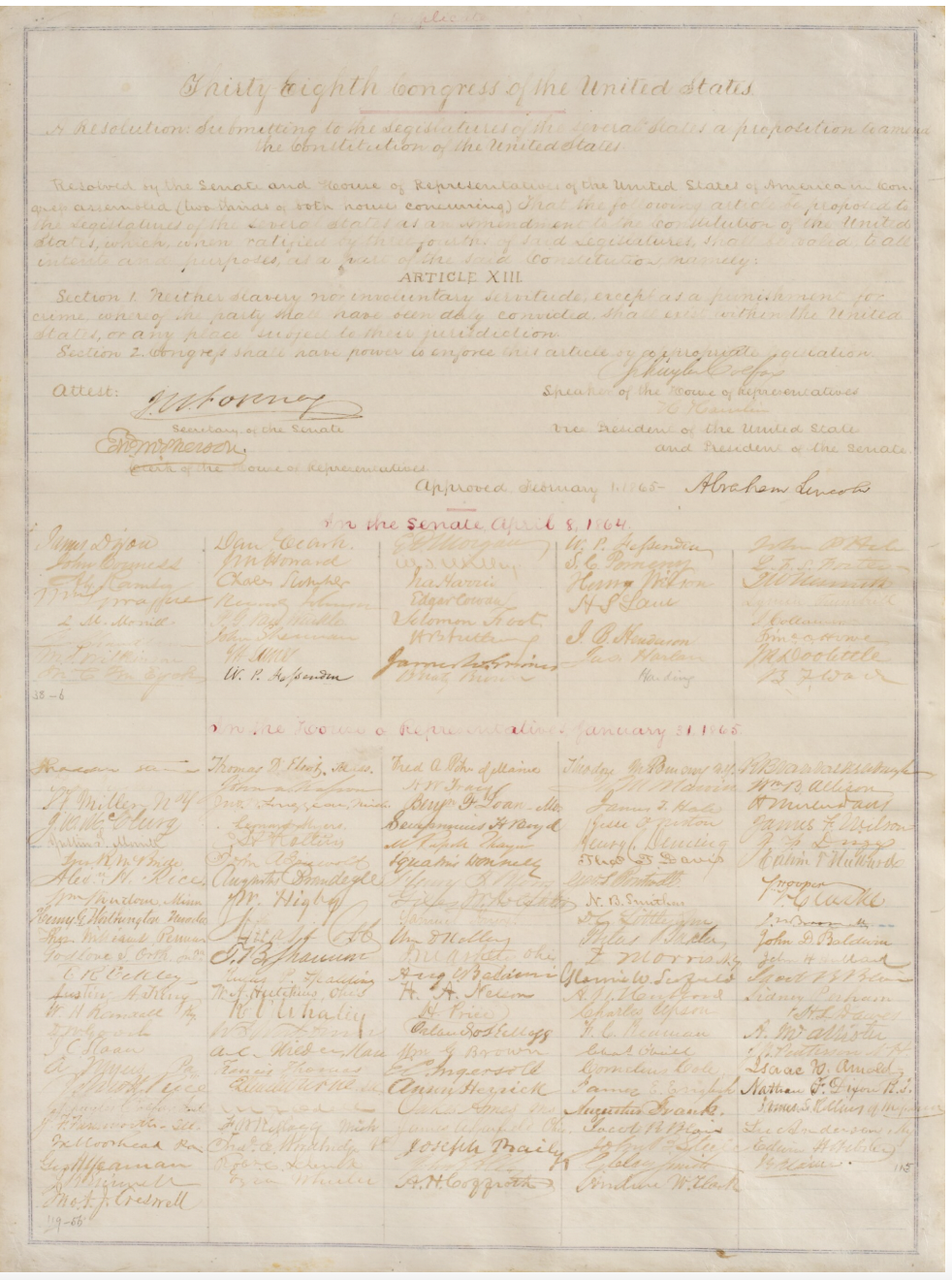
Manuscript copy of the Thirteenth Amendment, signed by Abraham Lincoln, abolishing slavery in the United States.
One of the finest and most complete Lincoln signed copies of the 13th Amendment abolishing slavery in the US comes up at Sotheby’s in New York on June 26 with an estimate of $8-12 million. Section 1 states: ‘Neither slavery nor involuntary servitude, except as a punishment for crime, whereof the party shall have been duly convicted, shall exist within the United States or any place subject to their jurisdiction’. It is one of just 15 recorded Lincoln signed copies. A printed broadside document of the Emancipation Proclamation is estimated at $3-5 million.
A 1928 BIANCHI ( ITALY) VINTAGE CAR. UPDATE: THIS WAS UNSOLD
This 1928 Bianchi with timber spokes is lot 5 at R.J. Keighery’s sale of classic cars, traps, carriages and transport memorabilia in Waterford on June 16. The body of the model S5 is leather covered and the estimate is €20,000-40,000. There are eight vintage cars in the sale as well as traps, horse equipment, vintage signs and collectibles in a total of 185 lots. The catalogue is online.
William Crozier (1930-2011) – Desire of the Moon (1990). UPDATE: THIS MADE 17,000 AT HAMMER
Desire of the Moon by William Crozier leads Morgan O’Driscoll’s current Irish art online auction which runs until June 23. The oil on canvas is estimated at €15,000-25,000. There is a similar estimate on Muingelly V, an acrylic on paper by Donald Teskey. With estimates from €200 up there are 204 lots on offer. The sale offers paintings and etchings by Sean Scully, Charles Tyrrell, Elizabeth Cope, Arthur Maderson, Graham Knuttel, James Humbert Craig and Pauline Bewick, sculpture by John Behan, Michael Foley and Sandra Bell and many more artists. The catalogue is online.
This Irish giltwood side table and mirror by the renowned Arthur Jones cabinetmakers was shown at the Irish Industrial Exhibition in Dublin in 1853. Known as The Table of Ireland it features motifs like a harp, carved masks, shamrocks, an Irish high tower and a medieval town house. Oak leaves, acorns and a saintly figure playing a harp are in sharp contrast to a warrior about to draw his sword. Together they depict the dual forces of peace and war in Ireland’s storied history as seen in Victorian times. The mirror is crested by a figure of Hibernia sat on a sword in front of a Celtic high cross. The table is one of the highlights at Fonsie Mealy’s summer fine art and antiques sale in Castlecomer on June 18 and 19. The estimate for lot 809 is €15,000-€20,000.
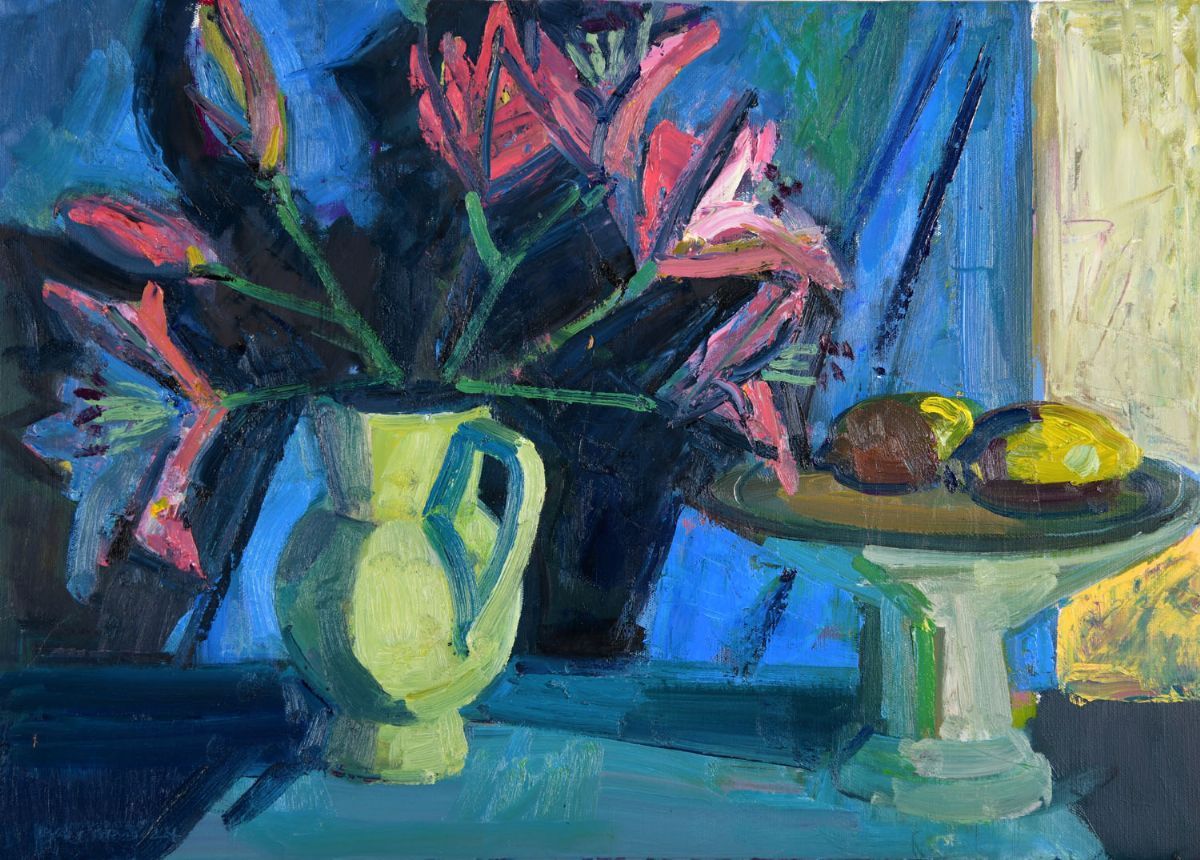
Lilies and Lemons by Brian Ballard at Gormleys online Irish and International art auction. UPDATE: THIS MADE 1,600 AT HAMMER
A total of 88 lots will come under the hammer at Gormley’s timed online Irish and International art auction which runs until the evening of June 10. There is art by Peter Curling, Nano Reid, Gladys MacCabe, William Conor, Mark O’Neill, Markey Robinson, Tom Wesselman, David Hockney, Sean Scully, Robert Indiana, Laura Knight and many more celebrated artists.
A Regency oval beaded mirror at James Adam. UPDATE: THIS MADE 4,200 AT HAMMER
Home or garden? The choice is yours at two appetising sales next week, the At Home online sale at Adams in Dublin on June 11 and the two day summer garden sale by Victor Mee in Cavan on the evenings of next June 10 and 11.
Top lots at Adams range from Playing in the sand, a lovely summer scene by Dorothea Sharp (1874-1955) (€4,000-€6,000) through a Louis Quinze ormolu mounted longcase clock (€3,000-€5,000), an Irish Regency oval beaded wall mirror (€3,000-€5,000) and a Milkmaid pattern Irish silver tea set (€2,500-€3,500).
A wrought iron glasshouse in Victorian style complete with modern accoutrements like remote control glass and automated vents (€18,000-€22,000) leads the offerings at Victor Mee. Lifesize bronze sculptures of a horse and jockey and a galloping horse are estimated at €10,000-€20,000 each, while bronze effect statues on pedestals of The Four Seasons, a bronze fountain with Mercury and a pair of 19th century wrought iron entrance gates are all estimated at €8,000-€12,000.
A bleached timber library table at Adams. UPDATE: THIS WAS UNSOLD
One of the more unusual At Home lots – for use when away – is a complete set of early 20th century 40 nautical signal flags. Originally drafted in 1855 the code is an international system of signals used by ships to convey important information on safety and navigation. The flags are in a fitted timber case with brass carrying handles and estimated at €400-€600.
With more than 500 lots the last At Home sale before the summer covers multiple objects for the home from a pair of brass framed circular hall lanterns to an Edwardian club fender and a pair of 19th century Sitzendorf porcelain wall sconces. There are lots of chairs like sofas and Chesterfields, a set of eight Windsor style oak and elmwood kitchen chairs, a pair of French 19th century two seater settees, a pair of red leather wingback armchairs, a George II walnut armchair, a pair of library armchairs, green leather button back chairs, a sent of c1820’s provincial Irish dining chairs along with Victorian and Edwardian dining chair sets.
Among the artworks on offer are two botanical watercolours by Wendy Walsh and Cattle Watering by Thomas Sydney Cooper. A pair of giltwood and marble figural console tables, a bleached timber library table, Georgian and Regency dining tables, side tables and card tables feature along with collectibles like silver, clock sets and a Baccarat three light candelabra.
An obelisk gifted by the Chinese government at Victor Mee. UPDATE: THIS WAS UNSOLD
At Victor Mee’s sale you will find exceptional urns and planters, a private collection of antique stone troughs and an obelisk gifted by the Chinese government to the Hely Hutchinson family at Knocklofty House in Clonmel. The two day sale features over 850 lots of garden statuary, furniture and architectural features.
There is a focus too on animal garden statuary with an emphasis on native irish wildlife. This is an area of collection which the team at Victor Mee has noted is growing in popularity as animal sculptures are increasingly used to add character and whimsy to Irish gardens. Among the offerings are hares dancing, a lifesize bronze sheep, bronze pigs, a cast iron red squirrel and a pair of boxing hares. More exotic creatures include a bronze elephant with a Dali style decoration and a bronze velociraptor. As always there is a good selection of antique and vintage outdoor furniture. Catalogues for both sales are online.
A raptor for your garden at Victor Mee. UPDATE: THIS MADE 2,350 AT HAMMER