antiquesandartireland.com

Information about Art, Antiques and Auctions in Ireland and around the world
  • ABOUT
  • About Des
  • Contact
  • Archive for the ‘Miscellaneous’ Category

    AL CAPONE’S .38 REVOLVER AT CHRISTIE’S

    Monday, June 6th, 2011

    Al Capone's revolver. (click on image to enlarge)

    Al Capone’s .38 revolver leads Christie’s arms and armour sale at South Kensington, London on June 22.  The .38 (Special) ‘Police Positive” nickel plated six-shot double action revolver was manufactured by Colt.  It has chequered walnut grips and retains nearly all its original nickel-plated finish. The serial number is 384221.

    Al Capone  (1899 –1947) is one of the most famous American gangsters. The stereotypical mobster image – blue pinstripe suit, tilted fedora – is based upon photographs of Capone, and his personality has been used as a template for copious fictional criminal masterminds. He once observed that:   “You can get much farther with a kind word and a gun than you can with a kind word alone”.
    The revolver is accompanied by a copy of an affidavit sworn on March 25,1990 by Madeleine Capone Morichetti, widow of Ralph Capone. This states that: “Ralph Capone became the custodian and owner of a certain Colt Police Positive .38 Special Revolver, serial no. 384221, being nickel plates with a wood handle, which revolver was acquired from and was the property of his brother Al Capone”. The affidavit also states that, according to Ralph’s wishes, upon his death the revolver was to be passed to one Edmund Koeski which it was in 1976.
    Estimated at £50,000-70,000 it will be sold with a further 209 lots, dating from the 10th century to the 20th century with individual estimates from £300 to £85,000.
    UPDATE:  The revolver sold for £67,250.  It was the top lot in a sale which realised £634,825.

    HISTORIC IRISH EASTER RISING TRICOLOUR TRAVELS TO U.S.

    Monday, June 6th, 2011

    The 1916 Tricolour.

    THE historic Irish tricolour flag flown over the headquarters of the Irish Volunteers during the Easter Rising of 1916 is headed for the United States.  The flag will be presented on loan to the American Irish Historical Society at Fifth Avenue, New York across from the Metropolitan Museum of Art.

    Now insured for $1 million the flag was captured by British soldiers after the surrender. It was later given to a doctor in Lisburn, Co. Antrium whose son in law donated it to the family of John Sweetman (1844-1936). He was one of the founders of Sinn Fein.
    The Sweetman family have loaned the flag to the American Irish Historical Society.  Ian Whyte of Dublin auctioneers will formally hand over the flat to Kevin M Cahill MD, President-General of the American Irish Historical Society, at the AIHS building, 991 Fifth Avenue, on June 8.
    Mr Whyte said: “the family are delighted to have this important icon of Irish history displayed in the AIHS in New York. The other flag that flew over the GPO during the Rising is in the National Museum of Ireland, and it is fitting that this tricolour is now in the USA, home to over forty million people of Irish descent”. It is hoped that the flag will be a focal point for the American commemorations of the Centenary of the Rising in 2016.

    TITANIC LAUNCHED IN BELFAST 100 YEARS AGO TODAY

    Tuesday, May 31st, 2011
    TITANIC was launched in Belfast on May 31, 1911 – 100 years ago today.  To mark the centenary artefacts recovered from the wreck went on display for the first time in Northern Ireland. Seven of the items – which will be displayed as part of TITANICa: The Exhibition at the Ulster Folk & Transport Museum – are on show for the first time anywhere in the world.

    This is one of several first-class glass serving dishes. Reminiscent of a ribbed shell, this candy or condiment dish has a modern appeal. The White Star Line logo is etched into the glass at the apex of the dish. ©1987-2004 RMS Titanic, Inc. (click to enlarge)

    This demitasse cup decorated with one of Spode’s famous cobalt blue designs is thought to have been used in the exclusive Café Parisien, adjacent to the à la carte Restaurant. The gold Greek key pattern within a cobalt field at the rim provides a striking pattern. ©1987-2004 RMS Titanic, Inc.

    This is one of several hand mirrors produced by “Royale Ivoire France.” The handle and backing are made of an early form of plastic created as a faux ivory which allowed for mass production. ©1987-2004 RMS Titanic, Inc.

    THE exhibition features 35 items from the wreck including a part of the hull structure, a porthole, silverware, glassware and personal belongings. They are part of a loan from US-based RMS Titanic, Inc a wholly owned subsidiary of Premier Exhibitions, Inc. and the Salvor in Possession of the wreck site.   Premier Exhibitions has conducted seven research expeditions to Titanic recovering more than 5,500 artefacts. In summer 2010 the company completed its eighth dive to collect scientific data and visuals on Titanic’s condition.
    These artefacts will join some 500 objects from the Folk & Transport Museum’s own collections. A magnificent 20ft long plan capturing last minute design changes to Titanic will be going on show for the first time. The plan has a significance which could never have been foreseen by the draughtsmen working at the Harland & Wolff shipyard a century ago. Meticulously drawn and annotated, it offers a unique opportunity to glimpse something of the world in which Titanic was built and the people who built and sailed on her.
    Part of the exhibition at the Ulster Folk & Transport Museum enables the visitor to step back in time to uncover life in Belfast 100 years ago. Daily routines and  activities from the shipyard worker’s home, to the carpenters workshop, to Kelly’s Coal Yard at Belfast Lough are re-created.  The exhibition runs until August.
    The plan of the Titanic used in the inquiry into the sinking of the ship in 1912 sold for £220,000 at Devizes-based Henry Aldridge & Son in England last week. Commissioned by the British Board of Trade it had been estimated at £100,000-150,000.  The auctioneer said the sale aroused interest from around the world.

    HISTORIC AUTOGRAPH MANUSCRIPT BY JANE AUSTEN AT SOTHEBY’S

    Monday, May 23rd, 2011

    JANE AUSTEN'S MANUSCRIPT OF ‘THE WATSONS’ (estimate £200,000-300,000). (click on image to enlarge) UPDATE: IT MADE £993,250, triple the pre-sale estimate.

    The historic autograph manuscript of Jane Austen’s unpublished novel ‘The Watsons’ – the only major Austen manuscript remaining in private hands – is due up at Sotheby’s sale of English Literature and History in London on July 14.

    The heavily corrected draft, the most important Jane Austen item to come to the market in over 20 years, was probably written in 1804. It is the earliest surviving manuscript for a novel by Jane Austen. The work remains incomplete.  None of the manuscripts of her completed novels survive, with the exception of two draft chapters of ‘Persuasion’ (at the British Library), Austen’s juvenile work ‘Lady Susan’ (at the Pierpont Morgan Library, New York) and the fragment ‘Sanditon’ (at King’s College, Cambridge), the only other autograph novel manuscript of comparable length.
    ‘The Watsons’ centres on a family of four sisters – the daughters of a widowed clergyman. Its heroine is Emma, the youngest, who has been brought up by a wealthy aunt. When her aunt contracts a foolish second marriage, Emma is obliged to return to her father’s house and endure the crude husband-hunting of her two twenty-something sisters. She has, however, a close relationship with her eldest and most responsible sister Elizabeth. ‘The Watsons’ contains many of Austen’s perennial themes and her genius for shrewd social observation:
    Emma Watson to Lord Osborne: “Your Lordship thinks we always have our own way. That is a point on which ladies and gentlemen have long disagreed. But without pretending to decide it, I may say that there are some circumstances which even women cannot control. Female economy will do a great deal my Lord, but it cannot turn a small income into a large one.”
    The novel is considered to be around a quarter completed. The manuscript, comprising 68 hand-trimmed pages, is estimated at £200,000-300.000. Well known to scholars, it was her  only literary composition between the completion of ‘Northanger Abbey’ in 1799 and the commencement of ‘Mansfield Park’ in 1811.

    EARLIEST RULES OF CLUB FOOTBALL TO BE SOLD BY SHEFFIELD AT SOTHEBY’S

    Sunday, May 1st, 2011
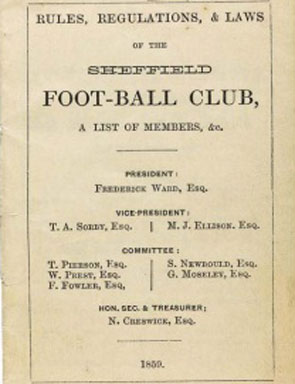
    The earliest rules of club football will be sold by Sotheby’s in London on July 14.  The document is part of the archive of the world’s oldest football club, Sheffield FC which was established in 1857.   They are estimated at  £800,000-£1,200,000.  The  lot  includes  both  the  original handwritten  draft  rules  (1858)  and  the  only  known  surviving  copy  of  the  printed  Rules,  Regulations,  &  Laws  of  the  Sheffield  Foot?Ball  Club  (1859).
    The  1858  rules  promoted  a  passing   game  played  with  the  feet, and included  the  free  kick,  throw-in, goal  kick,  restrictions  on  handling the ball, and  the  banning  of  “hacking  or  tripping”.   The archive, which sheds light on the world’s first  vibrant  football  culture in Sheffield  in  the  1860’s, comprises club minute books.  These are from the 1850’s and ’60’s.  There is a volume of match reports from the early 1860’s.
    Chairman  of  Sheffield  Football  Club,  Richard  Tims,  commented:  “The  sale  of this  remarkable  piece  of  sporting  history  will  allow  Sheffield  Football  Club  to  develop  its  facilities  and  secure  its  future  as  the  home  of  grass?roots  football.
    In New York last December Sotheby’s sold James Naismith’s Founding Rules of Basketball from December 1891. The two page typed document, which was tacked up in a Springfield, Massachusetts YMCA gym, made $4.4 million dollars including buyer’s premium.
    UPDATE:  THE earliest rules of club football – sold as part of the historic archive of the world’s oldest football club, Sheffield – fetched £881,250  setting a record at auction for any item of football memorabilia. It was bought by an anonymous telephone bidder.

    CAMBRIDGE UNIVERSITY MARKS 400TH ANNIVERSARY OF SPEED’S 1611 MAPS

    Thursday, April 21st, 2011

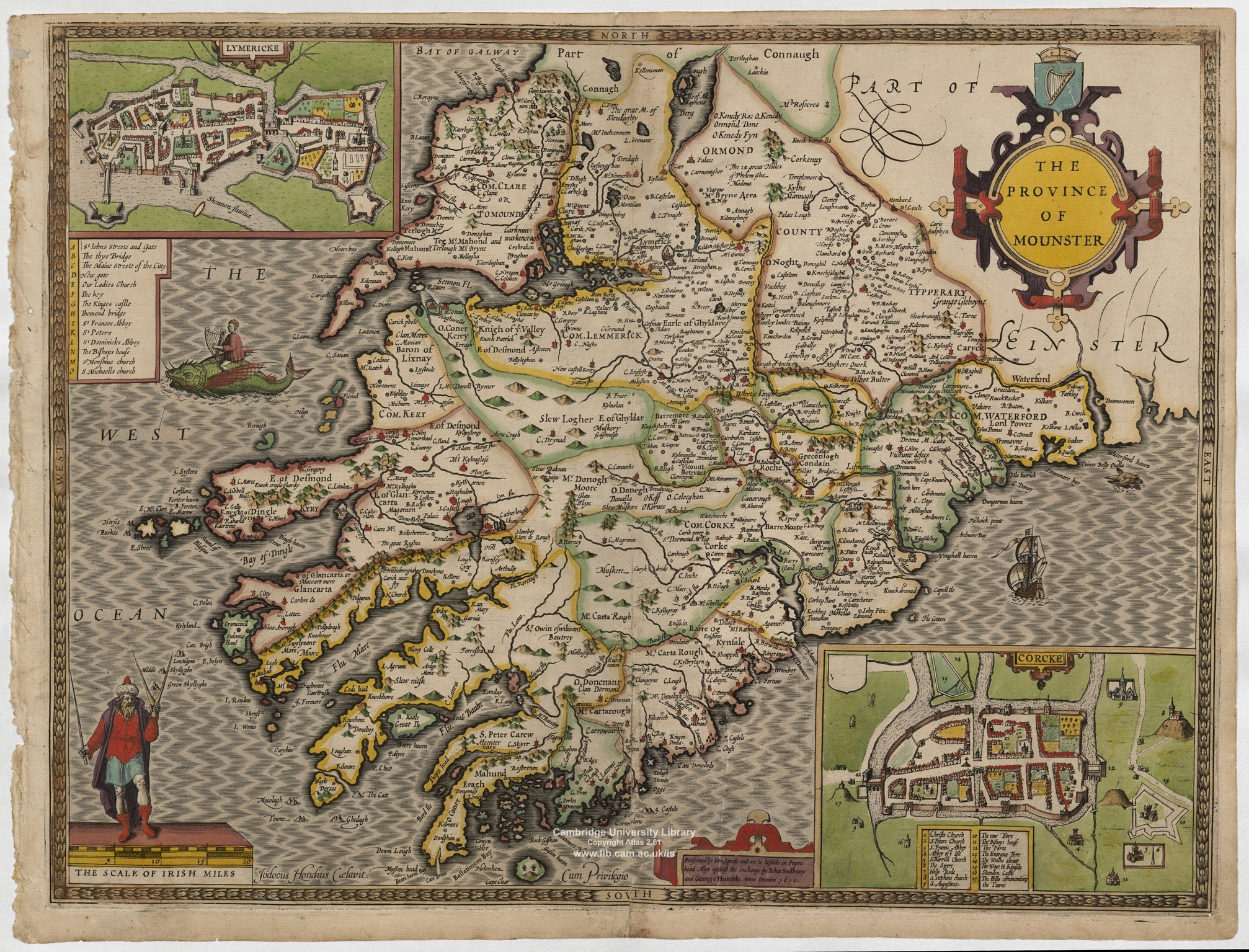
    Speed's 1611 map of Munster. (click to enlarge)

    Cambridge University Library is marking the 400th anniversary of John Speed’s Theatre of the Empire of Great Britaine.  Each of the proof maps is now available online at www.lib.cam.ac.uk/deptserv/maps/speed.html

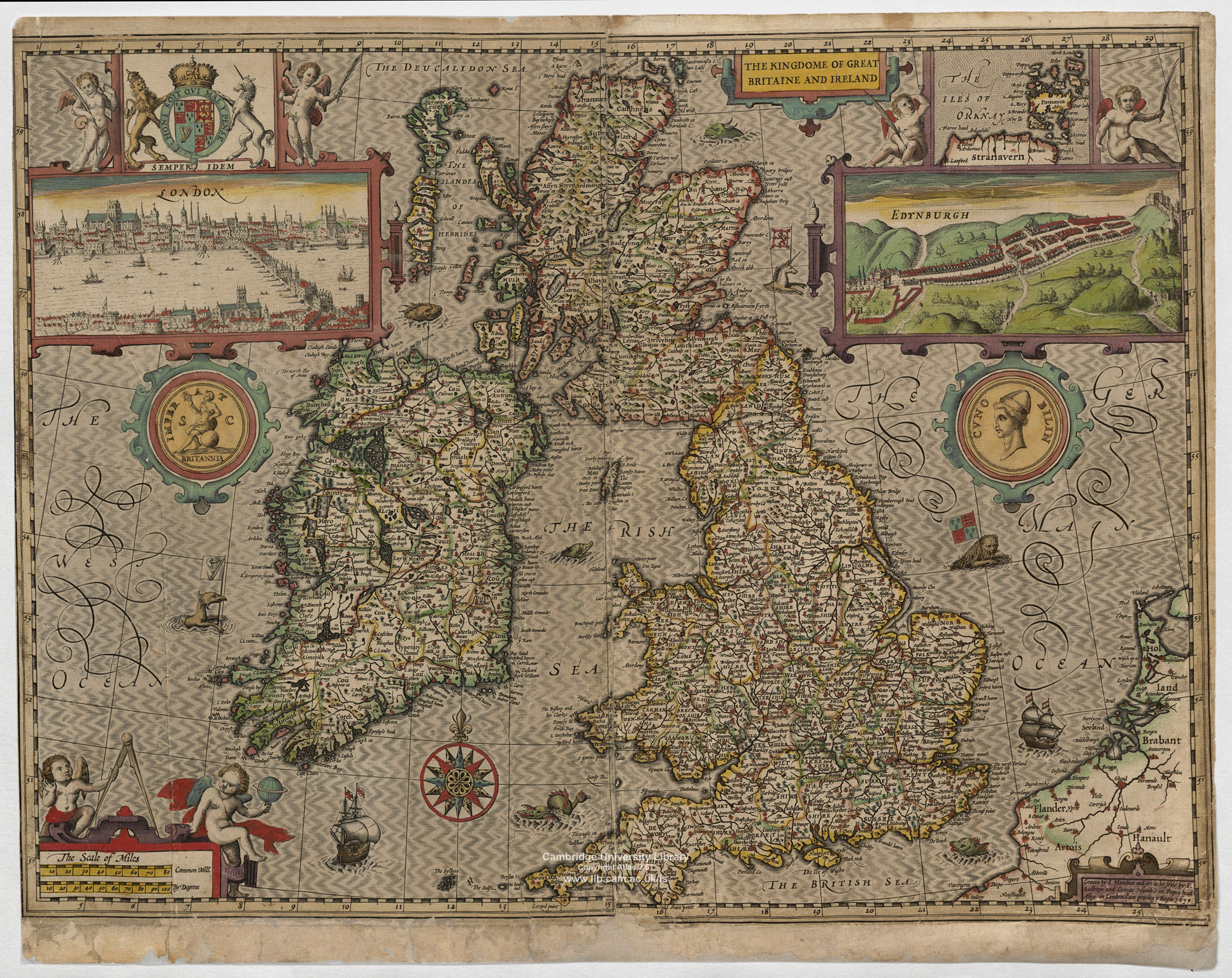
    Great Britaine in 1611. (click to enlarge)

    The production of this atlas in 1611 was the first time that plans of counties and towns became available in print.  A major innovation it was an immediate success. It was the first time that at least 50 of the 73 towns included were mapped.
    There is a single sheet for for each county of England and Wales, a map of Scotland and each of the four Irish provinces. The map of ‘Mounster’ (Munster) identifies ‘Lymerick’ and Cork as the two biggest cities.  The extensive coastline is emphasised by ships and green fish-like creatures emerging from the sea.
    Cambridge University Library is selling single copies of the 60 plus images that make up Speed’s masterpiece.  Anne Taylor, Head of the Map Department at the University Library, said: “Although the Library holds several copies of the published atlas – including a first edition – it is the hand-coloured set of proofs produced between 1603 and 1611 that is one of its greatest treasures.”
    Cambridge acquired the proofs in 1968 after the British government refused an export licence. By 1627 the atlas cost 40 shillings.
    Born in Farndon, Cheshire in 1551 or 1552, John Speed was an historian as well as a cartographer. He paid tribute to earlier map-makers whose work he drew on, especially the county maps of Elizabethan surveyor Christopher Saxton. Speed wrote:  “I have put my sickle into other mens corne”.

    ANTIQUE IRISH JEWELLERY AND SILVER AT O’REILLY’S APRIL SALE

    Wednesday, April 13th, 2011

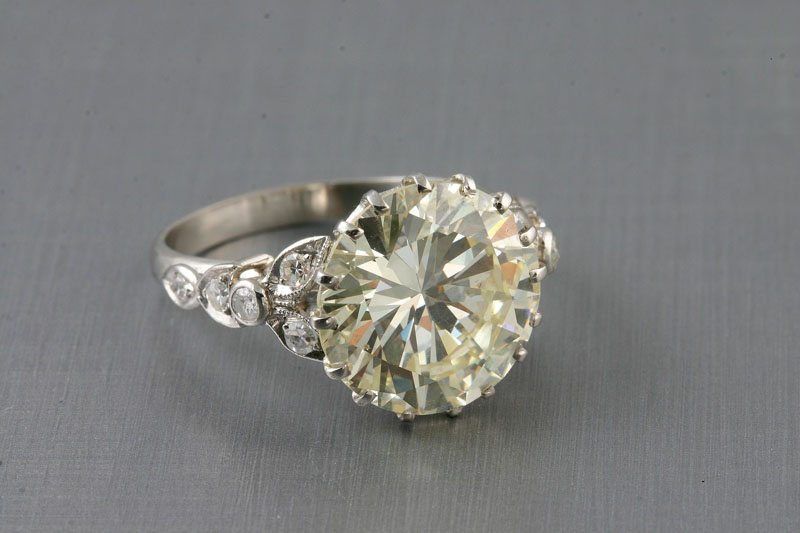
    A mid 20th century diamond ring, the old cut diamond set within a diamond set mount. Estimated; weight of diamond; 6.54 carat, colour and clarity; tinted, VS - SI, estimate 35,000 - 38,000 UPDATE: IT REMAINED UNSOLD

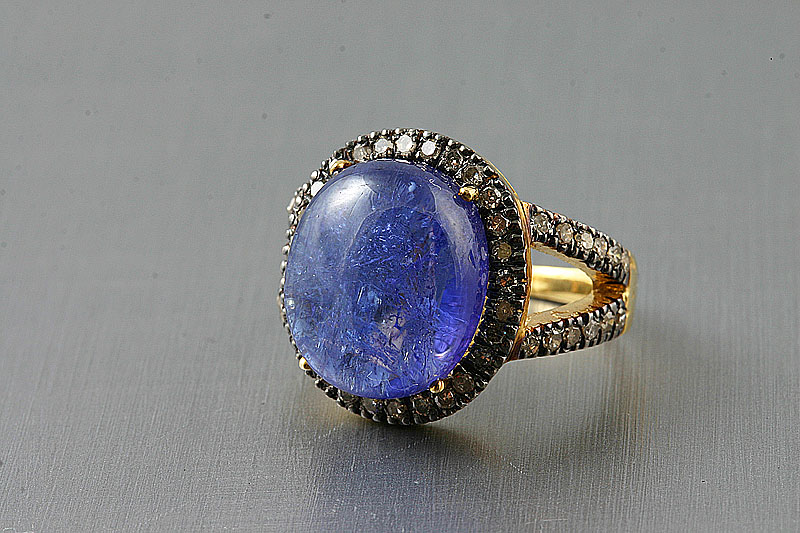
    A tanzanite and diamond dress ring, estimated at 600-700. UPDATE: THIS MADE 800

    An antique diamond set target ring, Estimated; weight of diamond; 3.50 carat, colour and clarity; K, VS, estimate 18,000 - 20,000 UPDATE: THIS MADE 17,000

    An Irish silver Victorian Armada jug, possibly by John Scriber, Dublin 1870, estimated at 3000 - 3500 UPDATE: THIS MADE 3,200

    Some lots from O’Reilly’s sale of jewellery, watches, antique gold, silver and paintings at Francis St., Dublin on Wednesday, April 20 at 1 p.m.

    The catalogue, which is on-line, lists 347 lots in total.

    CLICK ON ANY IMAGE TO ENLARGE IT.

    WHAT PRICE GIANT’S CAUSEWAY BASALT STONES?

    Friday, April 8th, 2011

    A collection of four hexagonal basalt column sections similar to those found at Ireland’s famed Giants Causeway is the first of 628 lots at Whyte’s History, Literature and Collectibles sale in Dublin on April 16.   They have been in the garden of a County Donegal home for at least fifty years. Whyte’s said it is possible they were acquired from Kennedy Quarries, Portrush, Co. Antrim  in the vicinity of land now belonging to the National Trust. Similar examples were auctioned at Summers Place Auctions in association with Sotheby’s on 19 October 2010 (lot 132) and realised £18,500.

    The Giant’s Causeway is the most popular tourist attraction in Northern Ireland. The unusual stone landscape was formed around 50 to 60 million years ago  when Antrim was subject to intense volcanic activity. Rapidly cooling molten basalt formed an extensive lava plateau in columns. Legend has it that the Irish warrior Fionn mac Cumhaill (Finn McCool) built the causeway to walk to Scotland to fight his Scottish counterpart Benandonner.

    Examples of these stones in private collections are extremely rare. The Causeway area has been National Trust property for many years. It is illegal to remove anything from the site.  These ones are estimated at 3,000-4,000.

    UPDATE: They sold for 2,000.

    A QUARTER OF A MILLION HITS AND GROWING

    Saturday, March 26th, 2011

    More than 250,000 hits were scored by this website in the month to March 25.  Figures from Google’s Webmaster Tools show that antiquesandartireland.com continues to grow.  Established last April it broke the 100,000 barrier of monthly hits at the beginning of December 2010.  In January and February the average number of monthly hits was 200,000.  This has now reached a quarter of a million from Ireland, the US, Britain and around the world.

    RARE EMERALD AND DIAMOND TIARA AT SOTHEBY’S

    Friday, March 25th, 2011

    An extremely rare emerald and diamond tiara – the most important to have come to auction in 30 years – will be offered at  Sotheby’s sale of magnificent jewels in Geneva on May 17. It  is composed of 11 exceptionally rare Columbian emerald pear-shaped drops which weigh over 500 carats in total. The tiara was commissioned by the First Prince von Donnersmarck for his second wife Princess Katharina  (1862-1929). Their jewellery collection was known to be on a par with, or even to have exceeded, those of many of the crowned heads of Europe.
    The emeralds may have originally adorned the neck of a Maharajah and are believed to have been in the personal collection of Princess  Eugénie. It is thought the piece may have been commissioned from renowned jewellers Chaumet.  The estimate is £3.1-6.2 million (CHF 4.5-9 million / $5-10 million). (click on image to enlarge)
    UPDATE:  IT MADE  CHF 11,282,500/ $12,736,927, the highest price ever achieved for a tiara at auction.