Irish 19th Century mahogany Bureau stamped J.Kerr & Co., No. 68931. UPDATE: THIS MADE 9,500 AT HAMMER
By family tradition this bureau was a gift from Sir Winston Churchill to General Sir Bindon Blood. It comes up as lot 576 at Fonsie Mealy’s sale in Castlecomer on March 5 and 6 with an estimate of €1,000-€1,500.
Churchill served under Blood on the North West Frontier in 1897 and dedicated his first non-fiction book – The Story of the Malakand Field Force – to him. Churchill’s dedication reads: “Major-General Sir Bindon Blood, K.C.B., under whose command the operations therein recorded were carried out; by whose generalship they were brought to a successful conclusion; and to whose kindness the author is indebted for the most valuable and fascinating experience of his life”.
Born in 1842 Blood attended The Royal School, Banagher, Co. Offaly, Queen’s College, Galway and the Addiscombe Military College before being commissioned in the Royal Engineers in 1860. After service in Egypt, Afghanistan, India and South Africa he retired to London in 1907. He was made colonel commandant of the Royal Engineers in 1914 and worked to recruit soldiers for the First World War. He was aged 94 when he was made Chief Royal Engineer in 1936. He died in 1940.
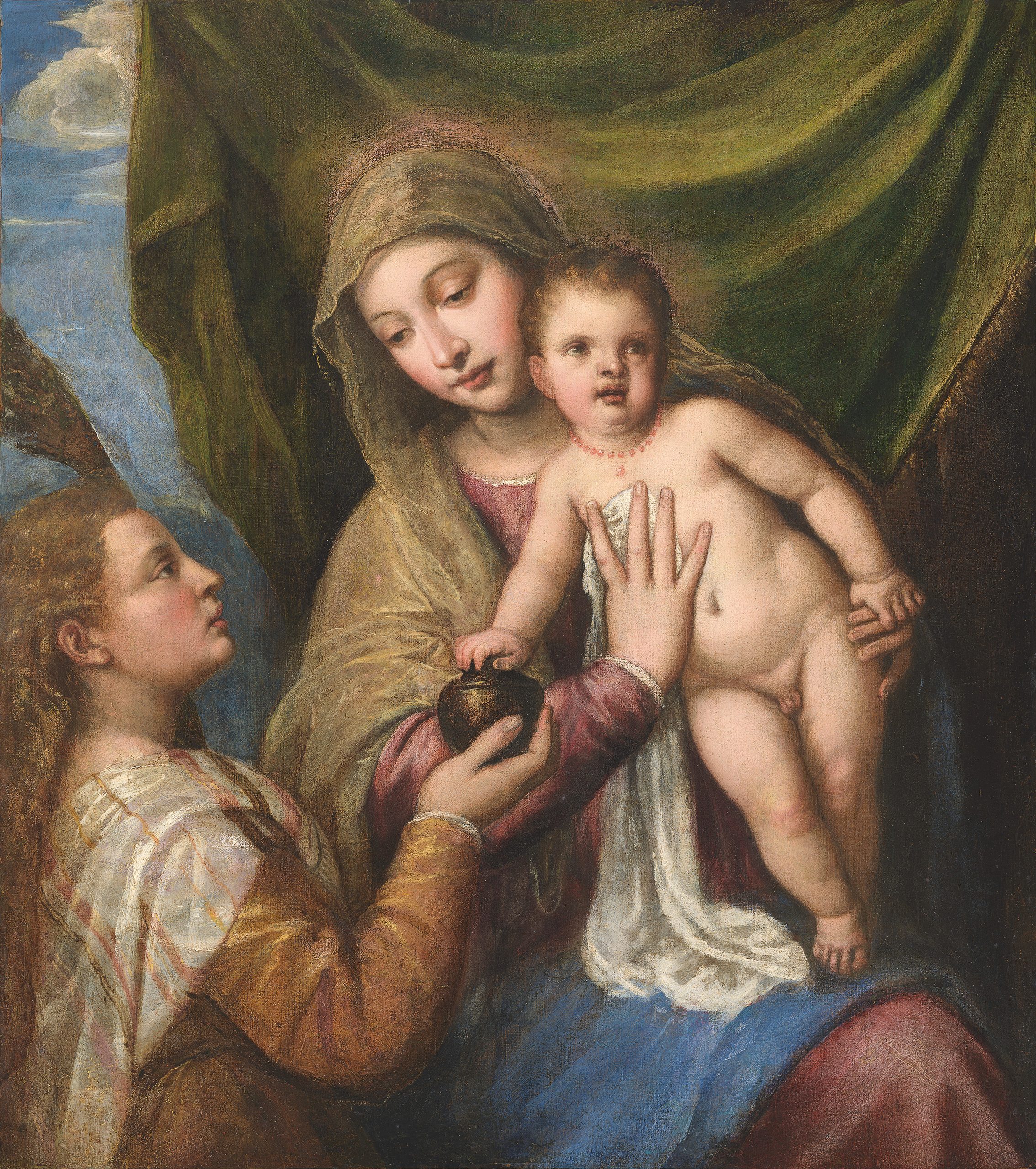
Tiziano Vecellio, known as Titian – Madonna and Child with St. Mary Magdalene
Not every fair boasts a Titian but there is one among the highlights at TEFAF Maastricht which runs from March 15-20. Trinity Fine Art of London will bring this painting by the Venetian master of a Madonna and Child with St. Mary Magdalene dated to around 1555-1560. It is being brought to light after being hidden from public view in various private collections for more than two centuries. The picture is remarkable for its sophisticated composition and emotional depth; the superb quality of the brushwork and the excellent condition of the painted surface give this picture the edge over other versions of the same subject hanging in some of the world’s leading museums, such as the Hermitage, the Gallerie degli Uf izi, and the Museo di Capodimonte. Fascinating details relating to Titian’s studio practices were revealed when the painting was X-rayed in 2024, in this case demonstrating how Titian modi ied and changed the composition
Francis Bacon – Portrait of Man with Glasses III, 1963. UPDATE: THIS MADE £6,635,000
Francis Bacon’s Portrait of Man with Glasses III from 1963 will be a highlight at Christie’s 20th/21st Century evening sale in London on March 5. At auction for the first time it has been exhibited extensively worldwide featuring in 17 major international retrospectives and serving as the cover image for the catalogue of the Francis Bacon/Henry Moore: Flesh and Bone exhibition at the Ashmolean Museum, Oxford in 2013. Most recently, it was displayed at London’s National Portrait Gallery as part of Francis Bacon: Human Presence, reaffirming its status as a cornerstone of Bacon’s oeuvre.
The painting’s distorted yet captivating features reflect Bacon’s deep exploration of emotion, form, and the human condition: the bared teeth, rendered with thick impasto and delicate colour, embody his ambition to “paint the mouth like Monet painted a sunset”. The estimate is £6 million – £9 million.
Telegram requesting a list of Titanic survivors on the Olympic
Titanic memorabilia or the early days of transatlantic aviation? The choice is yours at Julien’s online and live in California on February 27. Among a collection of Titanic relics are two telegrams from rescue ships Carpathia and the Olympic. One to Captain Herbert Haddock of the Olympic from the International Mercantile Marine Co. in New York requests a list of every survivor on the Carpathia, the other is from 2nd Class passenger Lucy Ridsdale to her sister in Milwaukee saying “safe”. There are serviceware items from Titanic and an envelope signed by all four surviving ships officers.
Another lot of local interest is the Pan Am 1938 Air Trails magazine and cover artwork of the Boeing 314 Clipper Flying Boat. There are no B314’s left today and the only full scale replica in existence is at the Foynes Flying Boat and Maritime Museum in Co. Limerick. This museum re-opens on March 15 after a winter break.
Pan Am 1938 Air Trails magazine and cover artwork of the Boeing 314 Clipper Flying Boat.
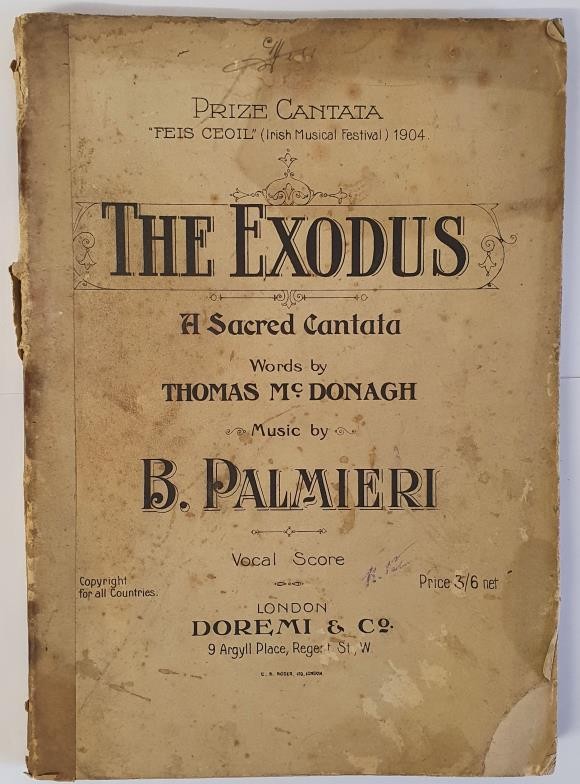
The book sale by Purcell Auctioneers in Birr on February 19 features The Exodus, a sacred cantata with words by activist, poet and playwright Thomas MacDonagh of Cloughjordan, a signatory of the 1916 Proclamation and music by B Palmieri. Published in London in 1904 it was for the Feis Ceoil and is estimated at €220-€440. The auction includes a selection of Irish and world interest books, antiquarian books, maps and ten lots of sporting memorabilia. UPDATE: THIS MADE 120 AT HAMMER
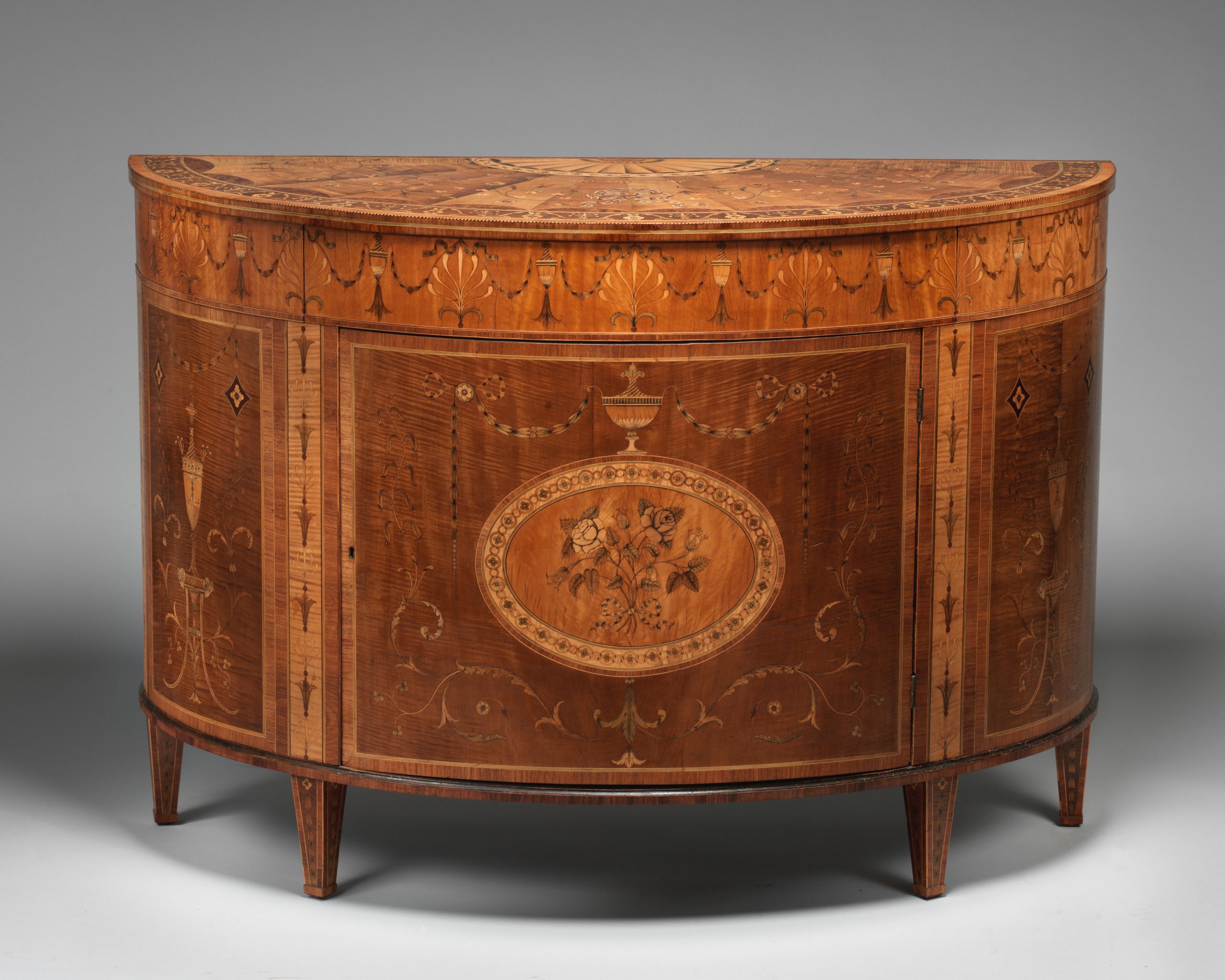
One of a pair of Irish commodes attributed to William Moore from the collection of the Metropolitan Museum in New York.
At a time of great global uncertainty and concern about Mr. Trump’s protectionist behaviour the Irish art market, though small, offers a ray of consolation. It demonstrates that tariffs don’t always work. Without them America built incredible collections.
Our VAT at point of entry – a tariff – has prevented Ireland’s art market taking any advantage from the fallout of Brexit in the UK. Five years on the gain to our art and antique market from that particular exit has been zilch.
Ireland has gained in finance market terms but the fallout from the damage to London’s status as a global art market hub has not benefited us in the slightest. Even though we are the only remaining English speaking country in the EU that gain has largely gone to France and Germany where VAT rates on art sales have been slashed.
France accounts for over 50% of all European art sales and between 6%-9% of global auctions since Brexit. Germany is next on the list. VAT can have an outsize effect on local art scenes because big hitting international collectors are attracted to countries where VAT rates are lower. In EU member states VAT is notoriously complex. In Ireland most artists will have to charge 13.5% VAT on their work and customs and VAT rates equate to 13.5% on art imported to Ireland.
No matter what the future holds in terms of trade barriers it looks at this stage as if it might not make much of a difference to an Irish art market where imports and exports are drowning in red tape.
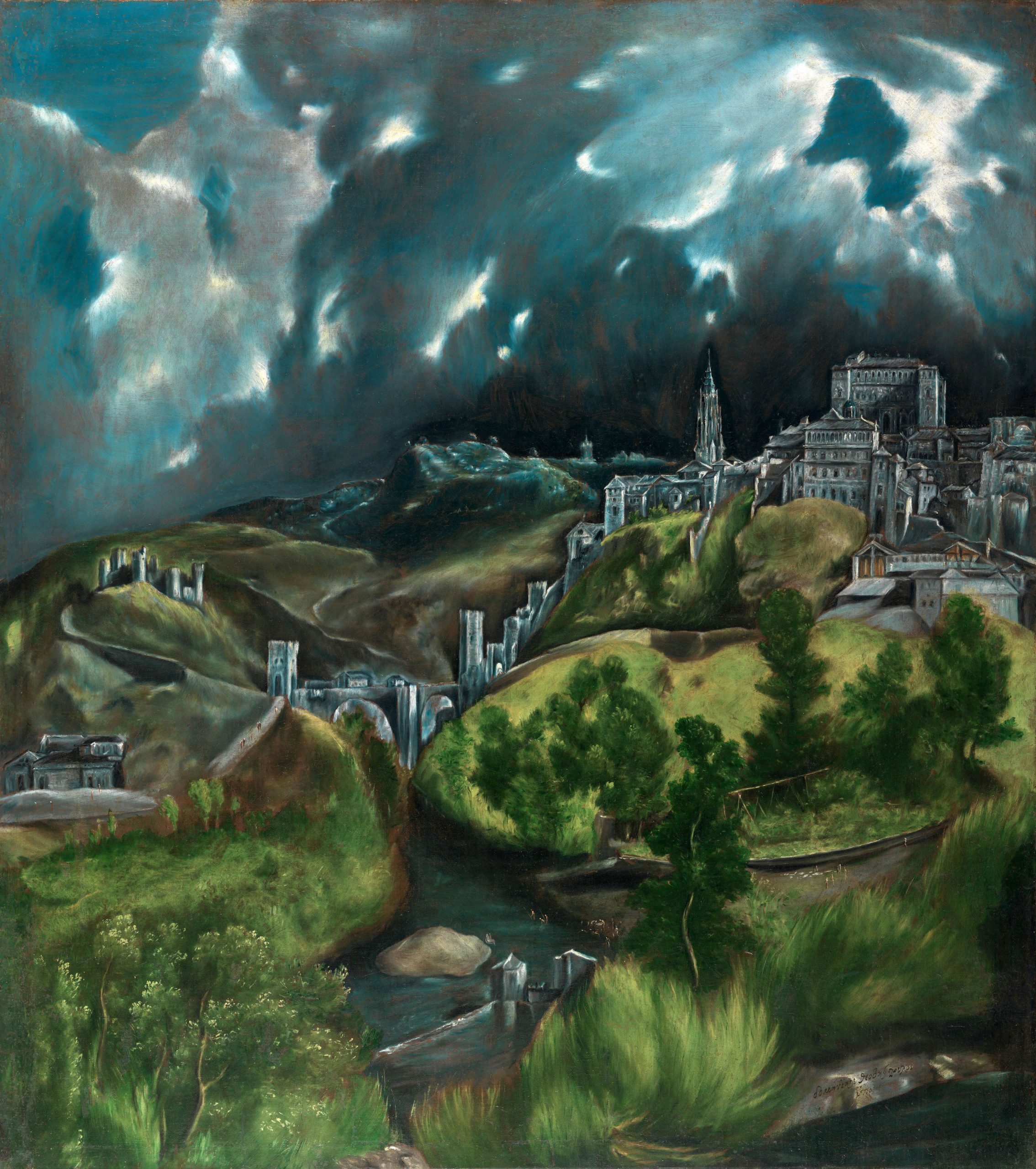
View of Toledo by El Greco, one of only two surviving landscapes by the artist, from the collection of the Metropolitan Museum in New York.
Acres of Monets and Manets, wall to wall Picassos and the very best of William Moore Irish 18th century furniture can be found in the US. America does not impose tariffs on the import of art and antiques which contributes in no small measure to the fabulous holdings of European art, sculpture and furniture in American museums and collections.
The lesson of this remains unlearnt in Ireland. The venerable Dublin firm James Adam has noted a decrease in the number of queries from the UK about selling and buying Irish art since Brexit. When they do get inquiries on an artwork of low value the advice to a potential UK seller is to forget about it. Before Brexit this was a much easier process. Nowadays red tape is time consuming, complicated and a turn off.
In contrast to France Brexit has resulted in a shrinkage in the amount of art coming to Ireland from the UK. And it has become very expensive for Irish art purchasers to buy in the UK. They must pay a premium which is usually higher than would be paid in Ireland, deal with exchange rates, artists re-sale rights payable by the buyer and on top of all that 13.5% for art imported into Ireland.
Even if many of us, rightly, condemn the disruption inherent in Mr. Trump’s tariffs in respect of the Irish art market at least Ireland can be accused of throwing stones in a glasshouse.
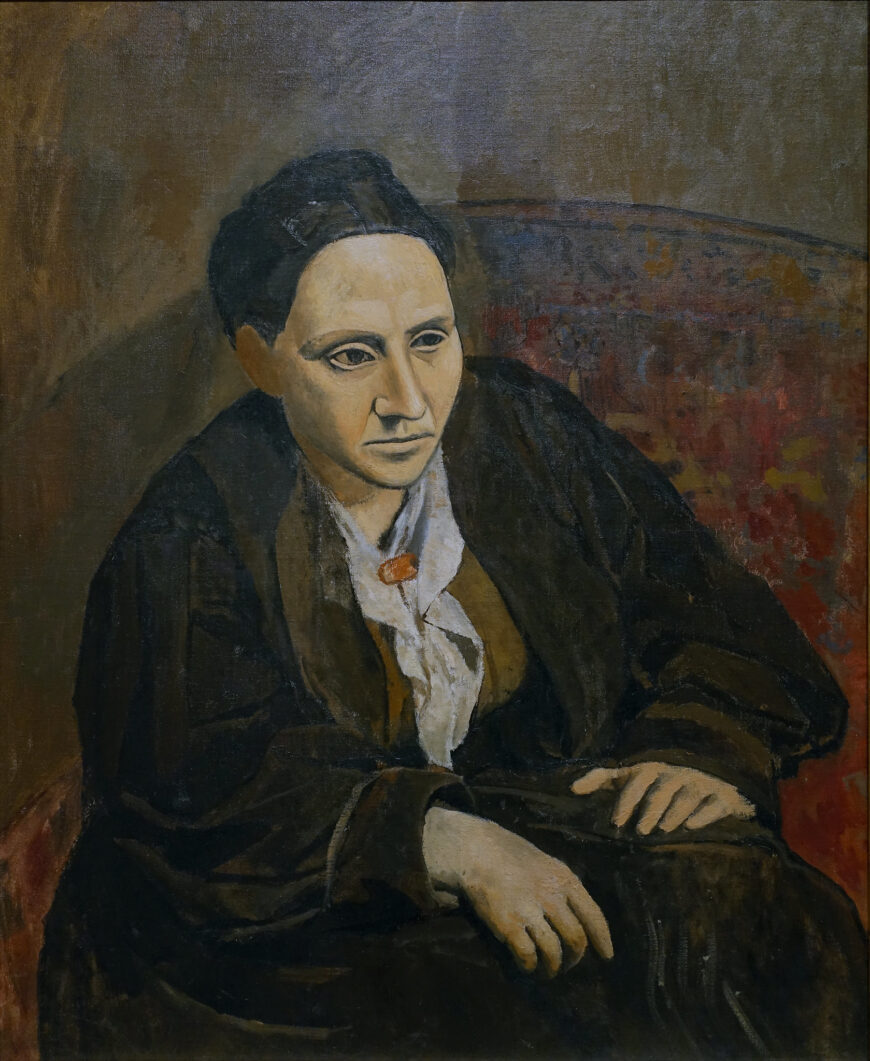
Portrait of Gertrude Stein by Pablo Picasso at the Metropolitan Museum of Art, New York.
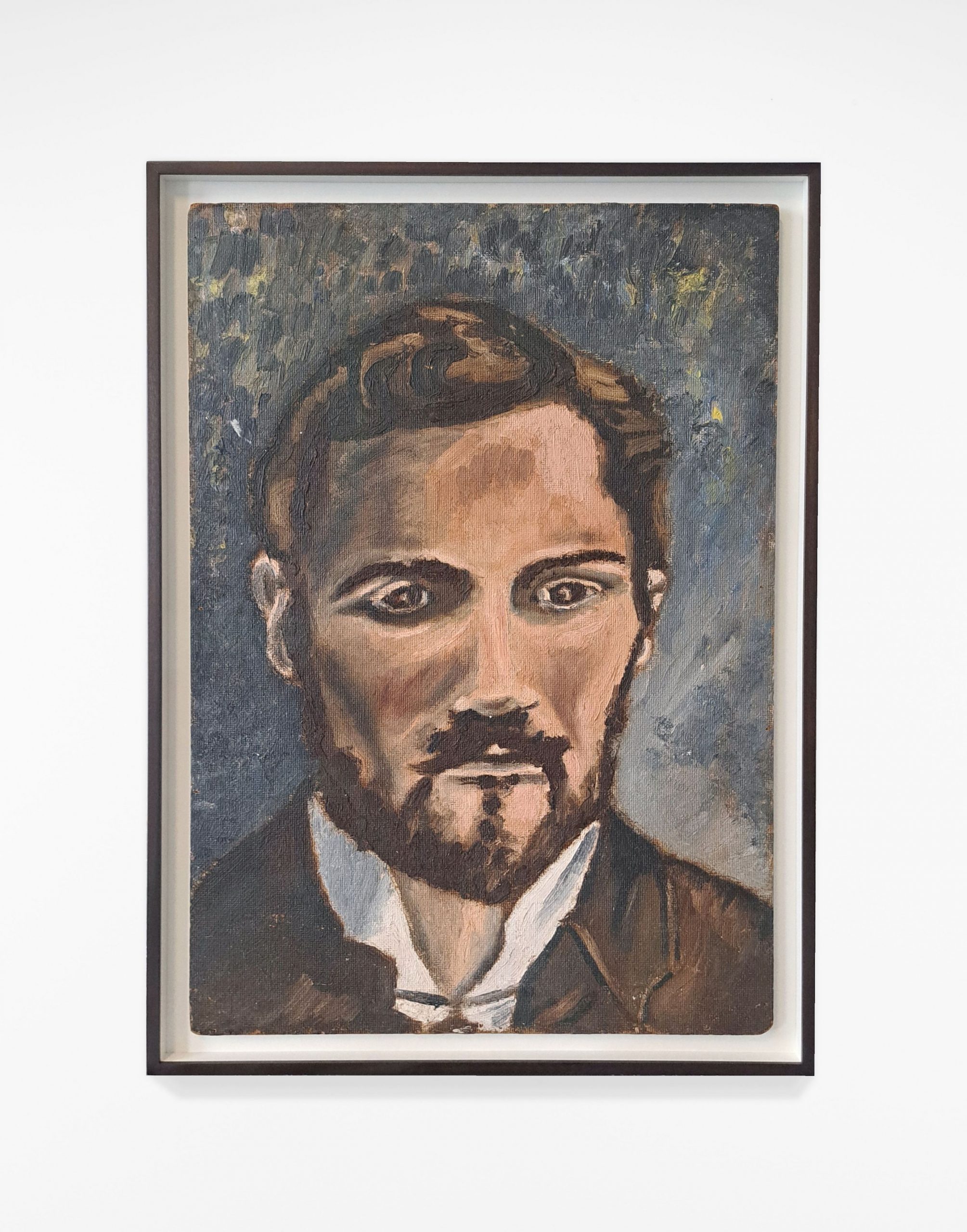
This a self-portrait by Christy Brown, renowned poet, novelist, and artist, has never been publicly displayed. It is a highlight of an exhibition opening at the Coach House Gallery in Dublin Castle today. The 1960 painting, long thought lost, is depicted in a well-known photograph of Brown at work in his studio. ‘All Flowers in Time Bend Towards the Sun’ is an exhibition by Irish and international artists across painting, sculpture and video which explores how artistic dualities coexist, interact, and ultimately rely on one another. Curated by artists Paul Hallahan and Lee Welch the exhibition draws inspiration from the layered contrasts found in the works of Flann O’Brien—rural versus urban, reality versus imagination, and seriousness versus humour.
The artists taking part are Nina Canell (SE), Elizabeth Peyton (USA), Lauren Conway (IRL), Christy Brown (IRL), Aleana Egan (IRL), Genieve Figgis (IRL), Paul Hallahan (IRL), Samir Mahmood (PAK/IRL), Maria Maarbjerg (DEN/IRL), William McKeown (NI), Mairead O’hEocha (IRL), Adrian O’Carroll (IRL), Linda Quinlan (IRL), Eva Rothschild (IRL/UK), Anne Tallentire (NI), Luke van Gelderen (IRL), Marcel Vidal (IRL), Lee Welch (IRL/USA) and Michael Warren (IRL). The exhibition runs until May 11.
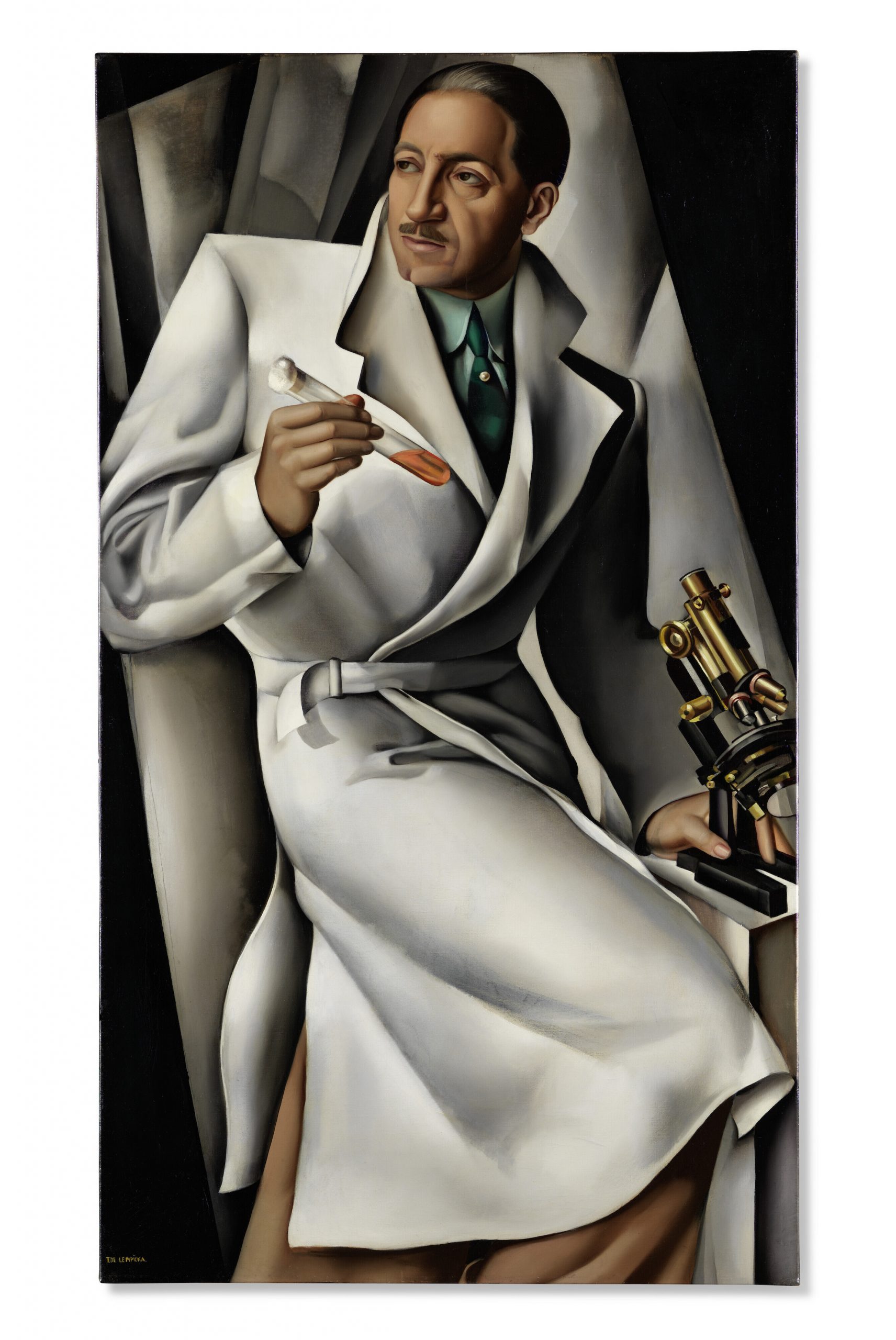
Tamara de Lempicka – Portrait du Docteur Boucard UPDATE: THIS MADE £6,635,000
This arresting 1928 Portrait of Dr. Boucard by Tamara de Lempica will be a highlight at Christie’s 20th/21st Century sale in London on March 5. From an important private collection the painting was commissioned from Lempicka by the sitter. Doctor Boucard was a prominent art collector and key patron of the artist. The work has not been seen on the market in the past forty years and is estimated at £5,000,000-8,000,000. An esteemed bacteriologist, Boucard revolutionised pharmaceutical science with the 1907 invention of Lactéol, a probiotic that laid the foundation for modern gut health research which is still in use today. Lempicka portrays Boucard as both an esteemed scientist and a man of distinction. His white trench coat, reminiscent of a laboratory coat, suggests a cinematic transformation. His upturned collar, pearl-accented tie, and sharply defined features convey both intellectual authority and cosmopolitan charm.
The first major U.S. retrospective of her wor at the de Young Museum in San Francisco. was co-curated by Furio Rinaldi and Gioia Mori. It opens at the Museum of Fine Arts, Houston on March 9.
Ludovico Mazzolino: The Crossing of the Red Sea (c.1480–1528)
Ludovico Mazzolino’s Renaissance masterpiece, The Crossing of the Red Sea, (1521) was unveiled at the National Gallery of Ireland today following an extensive research and conservation project. An exhibition supported by the TEFAF Museum Restoration Fund will run from February 15 to July 6.
Mazzolino, renowned for his small devotional paintings, primarily worked for the d’Este rulers of Renaissance Ferrara. Over time, he gained the confidence to undertake more ambitious and complex compositions. The Crossing of the Red Sea is one of only three surviving large-scale works by the artist, alongside The Massacre of the Innocents (Galleria Doria Pamphilj, Rome) and The Dispute in the Temple (Gemäldegalerie, Berlin). Recognised as a rare masterpiece, it serves as a crucial link between these key paintings from his mature career. Acquired by the National Gallery of Ireland in 1914, this remarkable work has remained out of public view for many years due to its fragile condition.
The restored painting is housed in a purpose-built microclimate frame and is presented alongside The Holy Family, (c.1500) by Lorenzo di Ottavio Costa (c.1460-1535), one of Mazzolino’s first teachers, offering insight into the artistic traditions that shaped his work, and the evolution of his distinctive style and technique. Also included is a smaller work by Mazzolino, The Tribute Money (c. 1527) from Christ Church, University of Oxford.
Lifelong activist and folk legend Joan Baez was among the visitors to La Grand Illusion, Brian Maguires exhibition at the Hugh Lane Gallery in Dublin which has been extended until May 18. From prisons in Ireland to the favelas of Brazil, and in countries like Syria and Sudan, the work of the internationally acclaimed Irish artist has always focused on inequality and violence. La Grand Illusion spans two decades of his artistic quest to draw attention to global injustice, war and human rights. The songbook of Joan Baez shines a similar spotlight. Amnesty International recounts that the work of the American singer includes marching for civil rights with Dr. Martin Luther King, fighting for the rights of California’s migrant farm workers alongside Cesar Chavaz, supporting gay and lesbian rights and travelling around the world to participate in human rights missions.