antiquesandartireland.com

Information about Art, Antiques and Auctions in Ireland and around the world
  • ABOUT
  • About Des
  • Contact
  • SHIP’S MANIFEST LINKS TO ANTIQUE BUTTER TRADE

    March 5th, 2012

    An historic ship’s manifest at Marshs auction in Cork on Saturday, March 10 harks back to the days when the Cork Butter Exchange was the largest butter market in the world.  Butter from Munster’s rich dairyland was exported in huge quantities from the city.  A framed manifest dated August 17, 1785 at the auction contains details of one such shipment.  It details the export of about 50 firkins of new loose butter “in good order and condition” shipped by William Crawford of Cork to London. A firkin is an old unit of measurement equivalent to about a quarter barrell.  It was sent on a vessel called the Thomas anchored in the river of Cork.  The manifest is signed by both William Crawford and Sam Seldon, skipper and master of the Thomas.  The freight charge was 25 shillings.  Cork city retains a Butter Museum in Shandon to this day. The sale features  a selection of antique furniture, porcelain, clocks, books and collectibles.

    The 1785 ship's bill of lading at Marshs. UPDATE: THIS SOLD FOR 500.

    This vitrine is at Marshs auction in Cork on March 10. UPDATE: It sold for 1,000 euro after the auction.

    RICH SELECTION OF IRISH SIDE TABLES AT CHRISTIE’S

    March 5th, 2012

    This c1760 Irish table with lion mask frieze is estimated at £40,000-60,000. Click on image to enlarge. UPDATE: IT MADE £46,850.

    A c1760 Irish side table with scallop shell frieze is estimated at £40,000-60,000. click on image to enlarge. UPDATE: IT MADE £39,650.


    A particularly rich selection of Irish side tables will feature at a sale at Christie’s in London on March 16.  There are 56 Irish lots in the sale of three collections, including Mount Kennedy in Co. Wicklow, at King St.  The total number of lots on offer is 316.  Irish pieces include tables, plate buckets, silver, delftware, two Malton prints, chairs, mirrors and a jardiniere.  A c1760 George II mahogany side table with carved gadrooned border and lion mask has an estimate of £40,000-60,000.  Another Irish George II side table of the same vintage with a trailing vine-leaf carved apron centred by a scallop shell between flowerheads, on acanthus-carved cabriole legs, on claw feet carries a similar estimate. A marble topped c1740-60 Irish side table once in the collection of Simon Sainsbury is estimated at £20,000-30,000.

    A c1750 Irish side table modified around 1830 with carving added to the side is estimated at £30,000-50,000. The frieze is carved with the crest of the Creagh family of Cork and Clare.

    ANTIQUE CORK FURNITURE AT LYNES AND LYNES

    March 3rd, 2012

    Antique Cork furniture at the Lynes and Lynes auction at East Link Business Park, Carrigtwohill, Co. Cork on March 10 includes side tables and a linen press.  The sale of 250 lots includes a number of Cork pieces includes side tables with estimates from 400 to 1,000 and a Georgian linen press estimated at 1,000-1,500.  There is an Irish Regency library chair, an antique dining table, a George III carved marble fireplace tablet, several antique chests of drawers and a 19th century brass bound military chest.  The auction includes silver, Waterford glass, books, paintings and a pair of blue and white Chinese lidded jars. The catalogue is on-line.  Here is a small selection (click on any image to enlarge):

    A George III marble fireplace tablet at Lynes and Lynes is estimated at 1,500-2,000. UPDATE: THIS MADE 2,400

    This pair of Chinese blue and white lidded jars is estimated at 300-500. UPDATE: THESE SOLD FOR 500

    A Georgian Cork side table is estimated at 600-1,000. UPDATE: THIS MADE 600

    This 19th century military chest is estimated at just 200-300. UPDATE: THIS MADE 440.

    An Irish Georgian linen press at Lynes and Lynes (1,000-1,500). UPDATE: THIS SOLD FOR 850.

    ORIGINAL PUGIN DRAWINGS AT IRISH ARCHITECTURAL ARCHIVE

    March 2nd, 2012

    An exhibition of original drawings by A.W.N. Pugin marking the bicentenary of the birth of the hugely influential Victorian architect is at the Irish Architectural Archive from March 2 to May 4.  More than anyone else he was responsible for the adoption of the Gothic Revival style which transformed the architecture of Britain and Ireland.

    Pugin is best remembered as one of the designers of the Palace of Westminster – Big Ben in particular.  His Irish buildings, including the Co. Wexford churches at Gorey, Tagoat and Barntown and the Cathedrals at Enniscorthy and Killarney, and the great seminary at Maynooth, are among his best.  Pugin visited Nuremberg in Germany in 1834 and returned in 1837.  Some sketches of interiors and decorations of Nuremberg’s churches from the second visit survive in the Irish Architectural Archive.  They are being presented in public for the first time.  The exhibition at Architectural Gallery, 45 Merrion Square, Dublin 2 is open from 10 a.m. to 5 p.m. on Tuesdays to Fridays.

    Pugin. Abbaye aux Hommes, Caen, France (Irish Architectural Archive). (Click on image to enlarge).

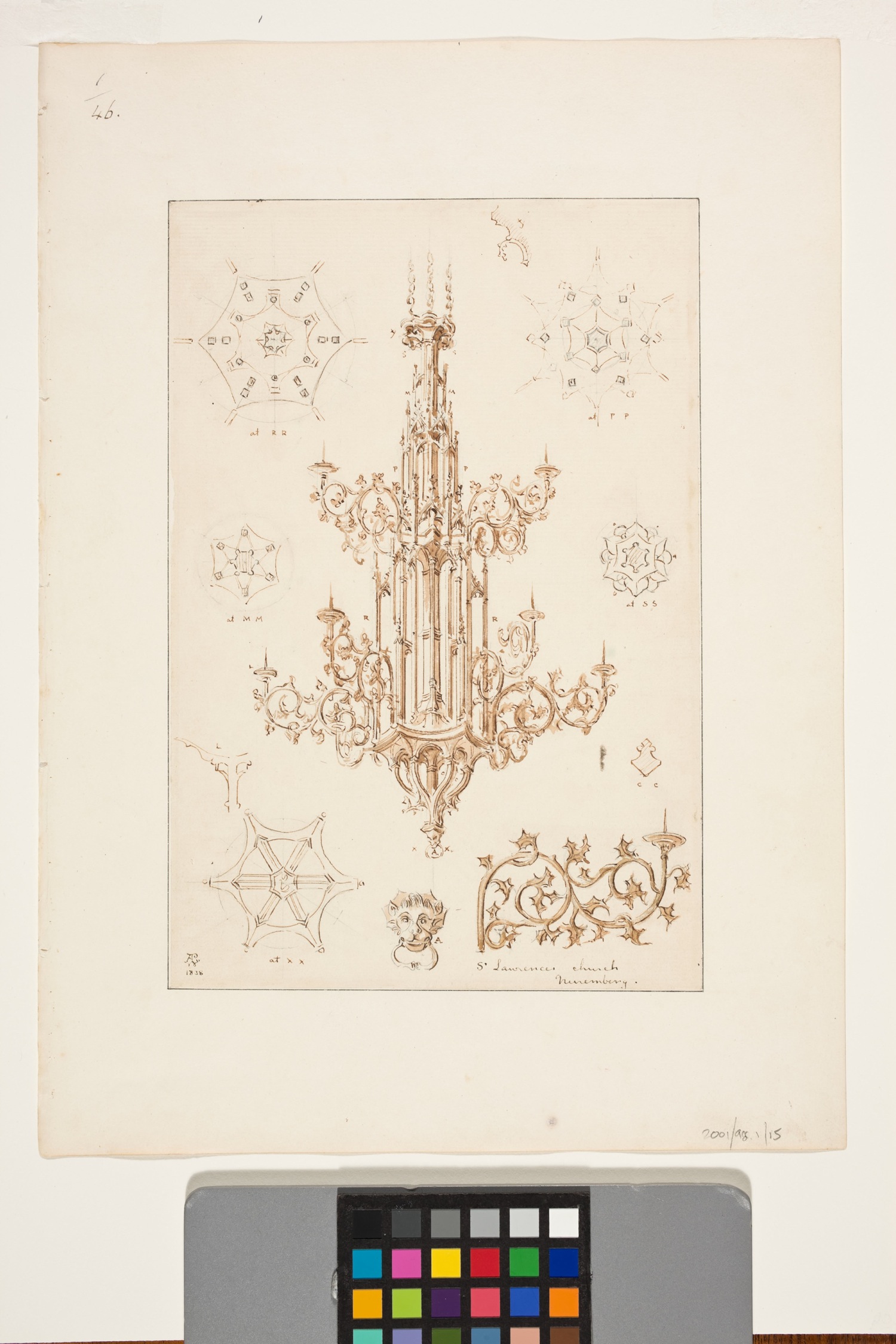
    Pugin sketch. Chandelier. Church of St Lawrence, Nuremberg (Irish Architectural Archive). (Click on image to enlarge).

    PLENTY TO TEMPT BARGAIN HUNTERS AT WHYTE’S

    March 2nd, 2012

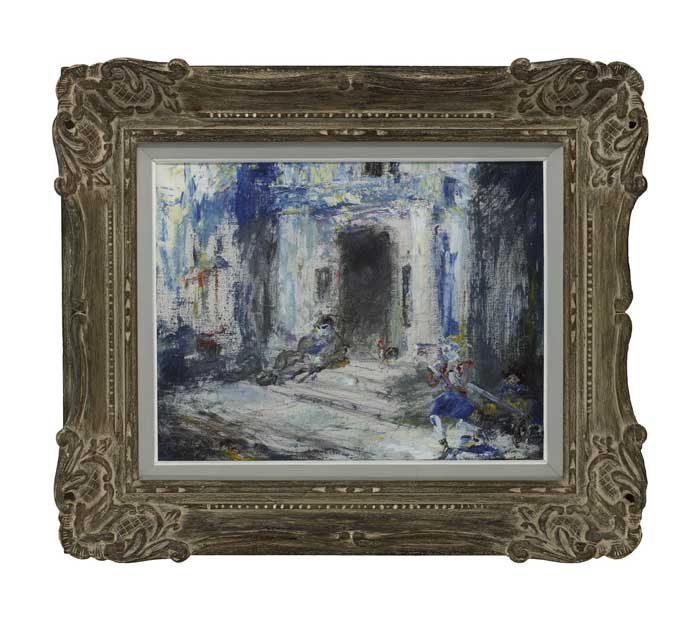
    PRICES for Irish art at auction remain on the low side so there is plenty to tempt bargain hunters at Whyte’s first sale of 2012.  The catalogue for Whyte’s sale on March 12, which will take place  in Clyde Hall at the RDS, lists 271 lots.  On the Courthouse Steps by Jack B. Yeats shows a vagrant resting on the steps of Naas Courthouse in Co. Kildare, his casual appearance in marked contrast to the classical formality of the building.  The most expensively estimated lot in the sale is expected to make 90,000-120,000.

    This is Whyte’s first sale of 2012.  It contains work by a broad cross section of Irish artists, north and south.  There is as well a work by Charles Edward Perugini, an Italian born British artist who married Charles Dickens daughter Kate in 1873.  His Lovers in a Garden is estimated at 50,000-70,000.  (UPDATE – IT MADE 48,000 in a sale that was over 70 per cent sold).  The catalogue for the sale is on-line. Here is a small selection:

    Jack Butler Yeats RHA (1871-1957) ON THE COURTHOUSE STEPS, 1946 (90,000-120,000) in orginal hand carved Waddington frame. Click on image to enlarge. UPDATE: THIS MADE 88,000.

    James Humbert Craig RHA RUA (1877-1944) OWEN CARA, COUNTY DONEGAL, c.1926 (3,000-5,000). Click on image to enlarge. UPDATE: THIS MADE 6,400.

    Thomas Snagg (1746-1812) VIEW OF CLONTARF CASTLE, 1805 (5,000-7,000). Click on image to enlarge. UPDATE: THIS MADE 9,000.

    Markey Robinson (1918-1999) THE GREEN DOOR, CONNEMARA (500-700). Click on image to enlarge. UPDATE: THIS MADE 700.

    ZHANG DAQIAN THE WORLD’S TOP SELLING ARTIST AT AUCTION IN 2011

    February 29th, 2012

    Zhang Daqian’s Self-Portrait in the Yellow Mountains made US$6 million at Sotheby's Hong Kong in October 2011. (Click on image to enlarge).

    The most expensive painting sold at auction in 2011 was Qi Baishi's Eagle Standing on Pine Tree; Four-Character Couplet in Seal Script.

    The year 2011 saw Zhang Daqian take the number one spot and the art market achieve an absolute record of  $11.5 billion dollars in global art auction revenue. Artprice’s global ranking of artist’s by auction revenue showed six of the top ten selling artists were Chinese. The best result of the year, $57.2 million, was achieved by Qi Baishi whose Eagle Standing on Pine Tree; Four-Character Couplet in Seal Script sold in Beijing last May.  Strong growth was sustained throughout 2011, a year in which art sold better than at any other time in history. This followed on a 2010 which produced the best performance of the decade.

    The Chinese market grew 49 per cent in 2011 but leading European markets grew too: +24% in the UK ($2.24 billion in 2011 vs. $1.81 billion in 2010), +9% in France  ($521 million vs. $478 million in 2010) and +23% in Germany ($213.9 million vs. $174 in 2010). In the Top 5 market places,  only the USA contracted with a revenue total of $2.72B, down 3% vs. 2010.  Artprice figures showed the global art auction market generated 21% more than in 2010. Compared with 2010, Modern art added $1.2B, Post-war art added $372m, Contemporary art added $291m, Old Masters added $124 million and 19th century art posted an increase of $43 million.

    The top ten selling artists at auction in 2011 were: 1. Zhang Daqian (1899-1983) – $550m; 2. Qi Baishi (1864-1957) – $510m; 3. Andy Warhol (1928-1987) – $325m; 4. Pablo Picasso (1881-1973) – $315m; 5. Xu Beihong (1895-1953) – $220m; 6. Wu Guanzhong (1919-2010) – $212m; 7. Fu Baoshi (1904-1965) – $198m; 8. Gerhard Richter (1932) – $175m; 9. Francis Bacon (1909-1992) – $129m and 10. Li Keran (1907-1989) – $115m.

    (See post on antiquesandartireland.com for April 7, 2011)

    DIAMOND WORN BY QUEEN MARIE de MEDICI AT SOTHEBY’S GENEVA

    February 28th, 2012

    The Beau Sancy diamond. (Click on image to enlarge). UPDATE: IT SOLD FOR $9,699,618 US dollars

    A 34.98 carat diamond worn in her crown by Marie de Medici at her coronation as Queen Consort of Henri IV in 1610 will be sold at Sotheby’s in Geneva on May 15.  The Beau Sancy, a modified pear double rose cut diamond has passed down through the royal families of France, England, Prussia and the House of Orange.  Acquired by Nicolas de Harlay, Lord of Sancy (1546-1629), in Constantinople in the mid to late 1500’s, the Beau Sancy is most likely to have originated from the mines in south-central India near the city of Golconda, the source of history’s best-known diamonds, including the Hope and the Koh-i-Noor.

    The Beau Sancy was bought by Henri IV and gifted to his wife. After the King’s assassination and the Queen’s escape to the Netherlands it was sold to Prince Frederick Hendrick of Orange-Nassau (1584-1647).  In 1641 it was used to seal the arrangement of the wedding of Frederick Hendrick’s son, Willem, later Willem II of Orange Nassau (1631-1660), to Mary Stuart, daughter of Charles I of England and Henriette-Marie of France, and grand-daughter of Marie de Medici. It was pawned to settle Mary Stuart’s debts.  It went back to Orange Nassau for the wedding of Willem III (1650-1702) to Mary II Stuart, daughter of the King of England James II.  Willem  and Mary ascended to the throne of England, but died childless and the diamond went back to Orange Nassau.  The Beau Sancy  subsequently became the principal ornament of the new Crown of Prussia. After the Second World War the Beau Sancy passed passed to the eldest son of the Kaiser, Kronprinz Wilhelm (1882-1951) and his son, Prince Louis Ferdinand (1907-1994). After the death of Prince Louis Ferdinand, the diamond was inherited as part of the estate by his grandson, Georg Friedrich (1976-), Prince of Prussia and current head of the Royal House of Prussia. Sotheby’s estimate it at $2-4 million/

    UPDATE: IT SOLD FOR $9,699,618 US dollars.

    LICHTENSTEIN’S SLEEPING GIRL AT SOTHEBY’S

    February 27th, 2012

    Roy Lichtenstein Sleeping Girl 1964 at Sotheby's New York. UPDATE: IT sold for $44,882,500

    Roy Lichtenstein’s Sleeping Girl from 1964  is a highlight of Sotheby’s sale of contemporary art in New York next May 9. The Pop Art masterpiece is one of the high points of the artist’s comic book inspired paintings and an icon of Post-War American art. Paintings from the series are in major museums around the world including MoMA, New York. This work has remained in the private hands for the past 48 years.

    “Sleeping Girl is one of the great masterpieces of the 20th century, counting iconic depictions of women by Pablo Picasso, Constantin Brancusi and Amedeo Modigliani among its peers,” commented Tobias Meyer, Sotheby’s worldwide head of contemporary art. “Lichtenstein’s ‘girls’ are arguably his most desirable works today and Sleeping Girl has been coveted since it was acquired in 1964, the year it was painted.  It is astonishingly fresh and vibrant, as if it were painted yesterday.” Prior to auction it will be shown in Los Angeles, Hong Kong, London and New York and is estimated at $30/40 million.

    It was purchased by noted West Coast collectors and philanthropists Beatrice and Phillip Gersh, from the Ferus Gallery in 1964. The Gershes were founding members of The Museum of Contemporary Art in Los Angeles (MOCA). Contemporary works by artists including Mark di Suvero, Susan Rothenberg, Tony Cragg and Kiki Smith will be offered from the Gersh collection at Sotheby’s this spring.

    LAVERY’S GOLF COURSE HIGHLIGHTS CHRISTIE’S AMAZING GOLF SALE

    February 24th, 2012

    The Golf Course by Sir John Lavery. (Click on image to enlarge).  UPDATE: IT SOLD FOR £193,250.

    Sir John Lavery’s depiction of The Golf Course at North Berwick is the most expensively estimated lot at Christie’s sale of the world’s most important private collection of golf art and memorabilia.  Passionately assembled over 25 years by Jaime Ortiz-Patiño, the founder of the world-famous Valderrama Golf Club, this historic collection includes some of the rarest and most valuable treasures representing the history of the sport. Ortiz-Patino, born in Paris in 1930, is the grandson of the Bolivian industrialist Simon Patino, known as the king of tin. The sale of 400 lots on May 30 is expected to realize more than £2 million.

    The collection includes golf clubs and balls used by champions including Allan Robertson, Old Tom Morris, Young Tom Morris and Willie Park Snr. who, between them, won twelve Open Championships.  Another highlight is the Morris Putter, a club owned by two of history’s most celebrated golf champions (£40,000 to £70,000). Crafted by Hugh Philp, a master club-maker based at St. Andrews whose thorn, apple and pear wood putters were particularly revered, it was owned and used by Old Tom Morris and his son Young Tom Morris who between them won eight Open Championships.

    The Golf Course, North Berwick by Sir John Lavery, R.S.A., R.H.A., R.A. (1856-1941) will be offered with an estimate of £200,000 to £300,000.  It last changed hands at Christie’s in 2005 for £456,000. It  is from a series of works the artist painted at the Scottish golf course in 1921 and 1922, another example of which is at Tate Britain having been presented by Lord Duveen. They are the most valuable and desirable modern depictions of the game.


    UPDATE:  Two works by Lavery, The Golf Links, North Berwick and The Golf Course, North Berwick sold for £241,250 and £193,250.  The sale brought in £1,838,731.

    18th CENTURY CARVED PALE GREEN JADE MOUNTAIN

    February 24th, 2012

    The carved jade gift to Prince Gong at Bonhams. (Click on image to enlarge). UPDATE: IT SOLD FOR £481,250.

    A magnificent pale green jade mountain, dating from the 18th century will be the highlight of Bonhams next Chinese sale on May 17 in London. It was a gift from Li Hong Zhang to Prince Gong, two of the most important statesmen of  the late Qing Dynasty. The piece is estimated at £400,000-600,000.

    The jade boulder is carved as a mountain peak in high relief with four sages and an attendant on a narrow ledge above a stream in a mountainous landscape with pine and wutong trees. The reverse is carved with rocky cliffs and trees. The nine character inscription reads: Jin Feng Gong Qing Wang Chen Li Hong Zhang (‘Humbly Presented [to] Prince Gong [by] Minister Li Hong Zhang). It comes with its original carved wooden stand and is 141/2 inches wide and seven inches high.

    Li Hong Zhang, GCVO (1823-1901), Premier of the Viceroyalty of Zhili, gifted it to Prince Gong,Yixin (1833-1898).   Prince Gong was the sixth son of the Daoguang Emperor (reigned 1821-1850) and half brother of the Xianfeng Emperor (reigned 1850-1861). He served as Prince Regent during the Tongzhi Emperor’s reign (1861-1875).  The carving passed by descent to his grandson Prince Gong.  Japanese dealers Yamanka and Co. offered it through the American Art Galleries in New York in 1913.  It was sold to a private English collector in London in 1963.

    UPDATE: IT MADE £481,250.