


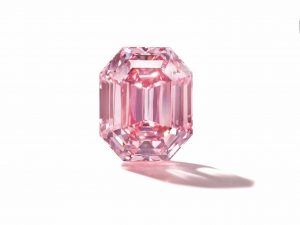
The Pink Legacy UPDATE: THIS MADE $50,375,000
THE Pink Legacy, the largest and finest fancy vivid pink diamond ever offered at auction by Christie’s come up in Geneva on November 13. Weighing just under 19 carats this exceptional rectangular-cut gem will lead Christie’s Magnificent Jewels auction at the Four Seasons Hotel des Bergues in Geneva. From the Oppenheimer Family it is estimated at US $30-50 million.
Rahul Kadakia, International Head of Jewellery commented:“The discovery of this previously unrecorded and remarkable diamond will cause immense excitement with collectors and connoisseurs of diamonds around the world. The Pink Legacy will be exhibited on a global tour prior to being auctioned on 13 November at the Four Seasons Hotel des Bergues. Its exceptional provenance will no doubt propel it into a class of its own as one of the world’s greatest diamonds.”
The Pink Legacy has been awarded the highest diamond color grading of VIVID by the Gemological Institute of America. Vivid coloured diamonds are the most strongly saturated gems, displaying the optimum hue of the stone. It is a classic rectangular cut diamond, a cut that is traditionally used for white stones, and weighs an extraordinary 18.96 carats. Most pink diamonds of this colour weigh less than a carat.
In the saleroom fancy vivid pink diamonds over ten carats are virtually unheard of. Only four vivid pink diamonds of over ten carats have been offered at auction. An historic level was reached last November when Christie’s Hong Kong sold ‘The Pink Promise’, an oval-shaped fancy vivid pink diamond of just under fifteen carats for US$32,480,500 (U$2,175,519 per carat), which established and remains the world auction record price per carat for any pink diamond.


 A rare Mitchell’s Old Irish Whiskey advertising mirror depicting Lismore Castle will come up at Victor Mee’s advertising and pub memorabilia sale in Co. Cavan on September 19. It is from the Crotty family of Lismore who have held the piece for at least four generations.


 In June 1919 the British aviators John Alcock and Arthur Brown made the first non-stop transatlantic flight from St. John’s, Newfoundland, to Clifden, Connemara in a modified First World War bomber which they crash landed in a field. Local man Jim Fawl removed a souvenir from the crash site, a wooden rib, probably part of an aileron. The piece of aviation history came to light almost one hundred years later on RTE’s National Treasures programme and has been on exhibition in the Museum of Country Life, Castlebar since then.


