Louis XV ormolu mounted desk at Woodwards. UPDATE: THIS MADE 650 AT HAMMER
A Louis XV ormolu mounted desk (€1,000-€2,000), a Sheraton inlaid bowfront sideboard (€600-€800), an Edwardian roll top desk (€750-€1,000), a small Irish Regency bookcase (€400-€500) and a pair of Edwardian demi-lune side tables €750-€1,000) give some indication of the value to be had at Woodwards online auction in Cork on March 29. Some or all of these pieces will be picked up for less than the low estimate. Antique furniture continues to represent very good value. More than 300 lots will come under the hammer.
The decorative interior sale at Victor Mee on March 26 and 27 can be viewed online too. More than 950 lots, headed by an antique Irish Georgian marble fireplace from the Castle Saunderson Estate in Co. Cavan and a cast iron gazebo, will come under the hammer over two online evening sales.
Irish Georgian marble fire surround at Victor Mee. UPDATE: THIS WAS UNSOLD
Louis le Brocquy – The Tain, Massing of the Armies II at Gormley’s. UPDATE: THIS WAS UNSOLD
From Walter Osborne to Andy Warhol, Louis le Brocquy to Paul Henry, the range of art on offer at four sales in Dublin next week is downright startling. Even though nowadays Irish art is sold at auction all year round there are still selling seasons. Early spring is one of them. The four sales on March 24, 25 and 26 at Whyte’s,de Veres, Gormleys and Adams will keep collectors busy and engaged. There is much to choose from across varying styles at all price points. In terms of expensive art the most significant sales are at Adams and Gormley’s. The top lot at each sale is a highly covetable tapestry by Louis le Brocquy. Cavanagh (€80,000-€120,000) at Adams next Wednesday evening used to hang at the Setanta Centre and featured here last week. The Tain, Massing of the Armies II at Gormley’s online on Tuesday evening is smaller and estimated at €90,000-€120,000. These artworks by one of Ireland’s leading and internationally renowned modern artists will reward a deep dive of exploration. The online sale at Gormley’s is on view at their new gallery premises on Francis St. in Dublin at the heart of the capital’s antiques quarter, previously Niall Mullen’s antique shop. Key pieces include Walter Frederic Osborne’s A Corner Of An Old Almshouse, Bruges (€60,000 – €90,000), Colin Middleton’s Three Kings (€40,000 – €50,000), Percy French’s West of Ireland Bogland ( €3,500 – €4,500), Banksy’s Grannies (€13,000-€17,000) and a screenprint by Andy Warhol titled Committee 2000 (FS II.289) (€14,000-€18,000). A total of 145 lots will come under the hammer at the Adams sale of Important Irish Art. Paul Henry, Mary Swanzy, Frank McKelvey, Tony O’Malley, Colin Middleton, Hilary Heron, George Russell, Gerard Dillon, Patrick Swift and John Shinnors feature among the leading artists on offer. The emphasis on the sale is on art from the 20th century and much of it is affordable. There is a good solid sale at de Veres timed online sale with bidding closing from 6 pm on Tuesday (March 25). Leading lots – all with top estimates of €20,000 and under – include work by artists who are sought by collectors including Dan O’Neill, Norah McGuinness, le Brocquy, Hughie O’Donoghue, Basil Blackshaw, Sir William Orpen and Harry Kernoff. The catalogue features 186 lots. The Spring online sale at Whyte’s, where the sale of Important Irish art on March 3 realised more than €1.2 million, is also brimful of interest and at a much lower price point. There are lithographs by William Scott, silhouettes by August Edouart, oils by Markey Robinson, a memory triggering painting of Collinstown Airport, Dublin in the 1940’s by Ivan Sutton among a selection of 265 lots in an estimate range of €80 to €5,000 at auction from 6 pm next Monday.
PICTURED BELOW: Ivan Sutton – Collinstown Airport, Dublin 1940’s at Whytes. UPDATE: THIS MADE 1,500 AT HAMMER
William Crozier – Still Life at de Veres. UPDATE: THIS WAS UNSOLD
Gerard Dillon – Abstract by Night at Adams. UPDATE: THIS MADE 7,500 AT HAMMER
“Andy Warhol – The 1950s Drawings from Daniel Blau” at the Dorotheum in Vienna on March 27 offers an extraordinary selection of works on paper with moderate starting prices. The 221 drawings are executed in pencil or ink, sometimes accented with gouache or collaged with adhesive tape, with starting prices from €800 to €4,000. Renowned Munich gallery owner Daniel Blau, son of painter Georg Baselitz, discovered the drawings in 2011 in Warhol’s personal estate at the Warhol Foundation Archive and acquired them. They have since been displayed in major touring exhibitions in Europe and the US. Blau is now parting with his Munich gallery. A second auction on March 28 features Daniel Blau’s collection of works on paper by George Grosz, Markus Lüpertz, Per Kirkeby, Neal Fox and others. After online bidding pre-bids lots will be auctioned in a virtual auction room at the Dorotheum, the largest auction house in central Europe. Pictured here is Untitled (Angel Playing the Trumpet) a c1955 ink on paper.
UPDATE: THIS MADE €9,888. ALL THE DRAWINGS FROM THE COLLECTION SOLD. An astounding 4,500 bids were submitted, sparking intense bidding duels in the virtual auction room, which lasted seven hours and continued late into the evening.
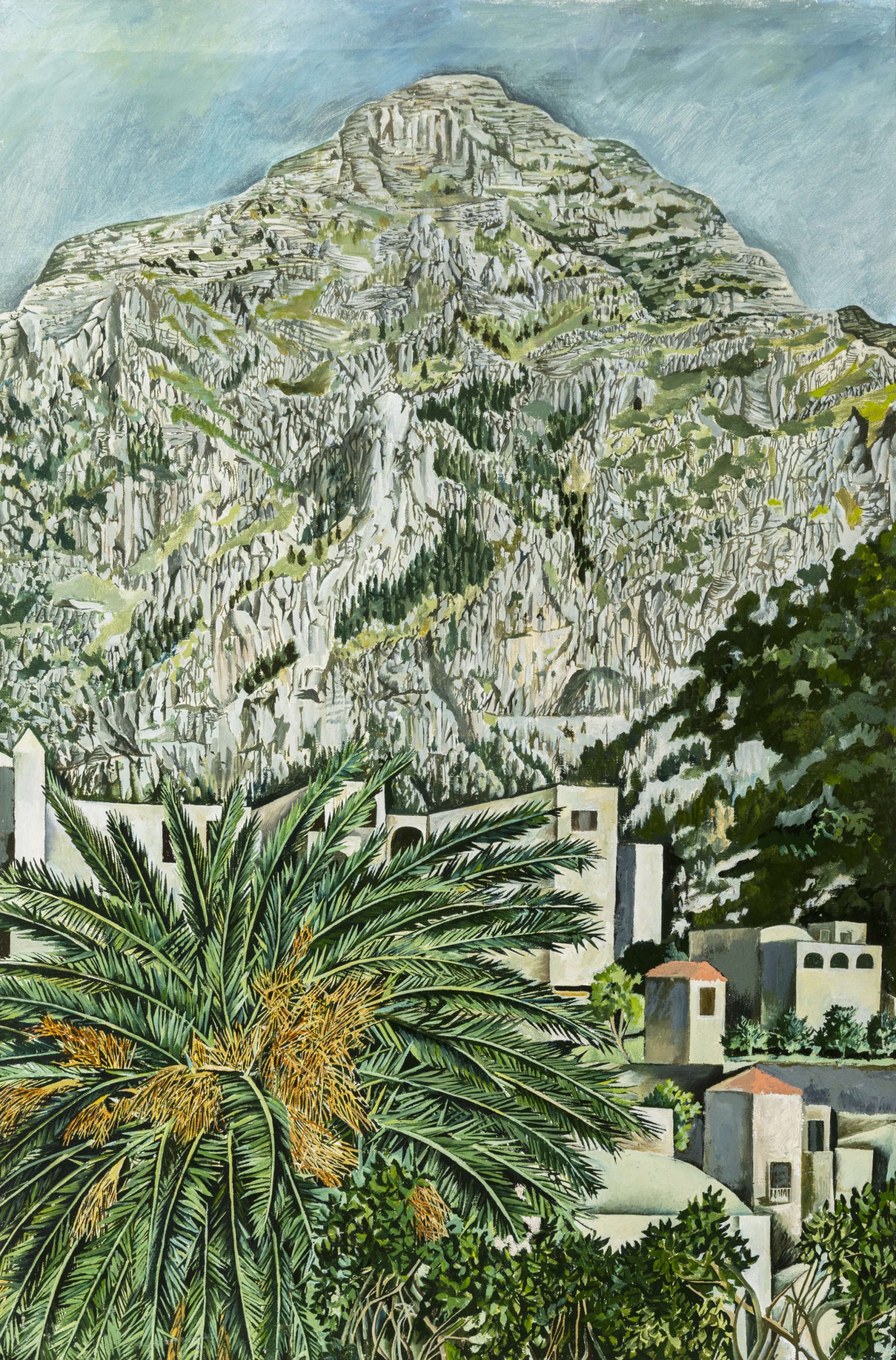
Patrick Swift (1927-1983) – Positano UPDATE: THIS MADE 28,000 AT HAMMER
Viewing for the James Adam sale of Important Irish Art in Dublin on March 26 gets underway today. A total of 145 lots will come under the hammer including Positano by Patrick Swift, exhibited at the Irish Museum of Modern Art in Dublin in 1993. It is estimated at €8,000-€12,000. The auction offers a wide array of paintings, tapestries, sculpture and print by many of Ireland’s best loved artists.
Mark O’Neill – Garden’s Rainbow. UPDATE: THIS MADE 3,700 AT HAMMER
Art and whiskey combine to make Dolan’s Spring auction, now live online, a cause to celebrate for collectors of all things Irish. Artists featured include Mark O’Neill, Arthur Maderson, Peter Curling, Norman Teeling, Susan Cronin, George Gillespie, Robert Egginton and Moyra Barry. The sale features a selection of Very Rare Midleton Whiskeys and there is antique furniture and collectibles, including stamps and books. The timed online sale runs until March 24.
A set of 10 Very Rare Midleton whiskeys. UPDATE: THESE MADE 4,600 AT HAMMER
DAN O’NEILL (1920-1974) – LANDSCAPE, TIRCONAILL. UPDATE: THIS MADE 15,000 AT HAMMER.
Landscape Tirconaill by Dan O’Neill (€15,000-€20,000) leads the timed online Irish art auction by de Veres which runs until March 25. Feeding Ground by Norah McGuinness is estimated at €14,000-€18,000.
With around 180 lots on offer estimates range from €80 up. Among the top lots at this auction is work by Louis le Brocquy, Hughie O’Donoghue, Basil Blackshaw, Harry Kernoff, Markey Robinson and William Crozier.
Norah McGuinness (1901-1980) – Feeding Ground UPDATE: THIS MADE 14,000 AT HAMMER
Roderic O’Connor – Paysage, Pont Aven, 1892. UPDATE: THIS MADE £378,000
Paysage, Pont Aven, an important and vibrant example of Roderic O’Conor’s stripe pictures, comes up at Christie’s Modern British and Irish art evening sale in London on March 19. It was exhibited in Paris at the 1892 Salon des Indépendents demonstrating its avant-garde approach and technique. The stripe pictures are generally accepted as the artist’s most desirable period. The estimate is £200,000-£300,000.
The auction features an interior by Sir John Lavery, The Hall, Argyll House, A summer’s day (1925). Argyll House on the King’s Road was home to Sybil Colefax and her husband Arthur in 1925. Known for her exceptional taste, she founded her business in the 1930’s and in 1938 was joined by John Fowler. Her business became known as Colefax & Fowler. The estimate is £100,000-£150,000.
Sir John Lavery – The Hall, Argyll House – A Summer Day, 1925. UPDATE: THIS MADE £157,500.
Cavanagh (1974) by Louis le Brocquy. UPDATE: THIS MADE 76,000 AT HAMMER
A large, colourful and unique tapestry by Louis le Brocquy, commissioned for Setanta House in Dublin in the mid 1970’s, is the leading lot at the James Adam evening sale of Important Irish Art on March 26. The Aubusson wool tapestry produced by Tabard Freres & Soeurs is estimated at €80,000-€120,000.
The catalogue cover lot is Pont du Gard by Mary Swanzy, an oil on canvas with a definite wow factor in which the artist painted a simplified Roman aqueduct with exceptional freedom. The estimate is €25,000-€35,000.
Pont du Gard by Mary Swanzy. UPDATE: THIS MADE 40,000 AT HAMMER
The Promised Land by Colin Middleton (€20,000-€30,000) was painted in 1947 when horrifying newsreel footage of the liberation of the concentration camps was widely viewed. Deeply deeply affected by these images Middleton here depicts two isolated and anonymous figures dispossessed by war caught up in swirling tides not of their own making and in search of a new land. Sadly this theme is as apposite now as it was in 1947. Plus ca change.
A c1886 Portrait Interior with Oriental Screen by Sir John Lavery is a chance discovery made when the vendor turned up at Adams looking for a valuation with no idea who the artist was. Adams had Lavery expert Professor Kenneth McConkey take a look and he confirmed the attribution. The oil on panel, measuring 42cm x 28cm, is estimated at €5,000-€8,000.
The Promised Land by Colin Middleton UPDATE: THIS MADE 22,000 AT HAMMER
Demand for George Russell (AE) is steady and consistent and there are a number of works by the artist in the sale, headed by An Apparition from 1921, an oil on canvas that reveals the influences of Symbolism (€8,000-€12,000).
The artist Gerard Dillon experiments with geometric forms, line and colour in Abstract by Night, a large scale work in an arresting palette of colours. The lot is estimated at €8,000-€12,000.
The auction offers art by John Doherty, Barrie Cooke, Camille Souter, Frank McKelvey, Lady Beatrice Glenavy, Sean Keating, Dan O’Neill, Hilary Heron, Tony O’Malley, John Shinnors, Cecil King, Felim Egan, Deborah Brown, Sarah Purser, James English, Pauline Bewick and many more artists among 145 lots. The sale is on view at Adams from March 21 and the catalogue is online.
William Scott (1913-1989) – Arran 1960. UPDATE: THIS WAS UNSOLD
This lithograph by William Scott, number 32 from an edition of 50, is at Whyte’s Spring online art sale which runs until March 24. Printed at the Curwen Studio and published by Johanna Schiessel Abstracta-Verlag, Freiberg it is estimated at €2,500-€3,500. Among the artists represented are William Orpen, Mary Swanzy, George Campbell, Gerard Dillon, Patrick Collins, William Scott, Robert Ballagh, Louise Mansfield, Harry Kernoff, John ffrench and Auguste Edouart. A set of four silhouettes by Edouart is estimated at €1,000-€1,500. The sale is on view at Whyte’s in Dublin from March 18.
Auguste Edouart (French 1789-1861) – A set of four silhouettes, three signed and dated. UPDATE: THIS LOT WAS UNSOLD
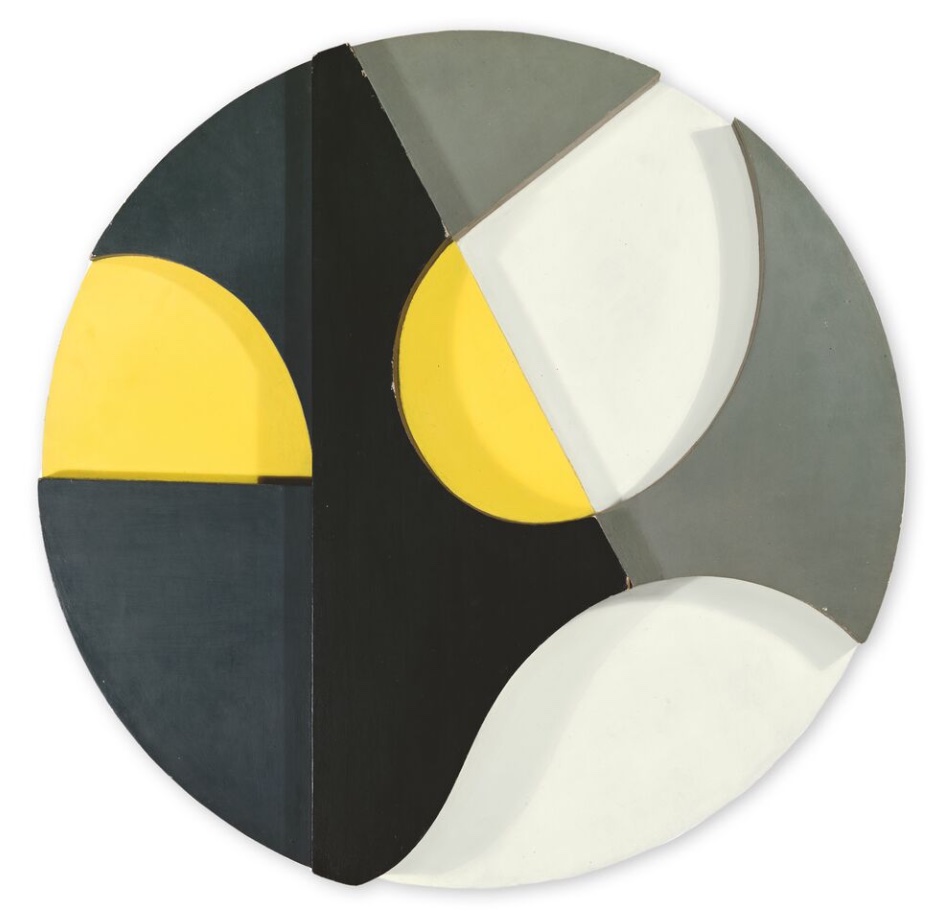
This painting by Sophie Taeuber-Arp – one of the major figures of modernity – is a highlight at Christie’s stand alone auction in Paris on April 8 of the collection Funck-Brentano. In 2021 and 2022, Living Abstraction – a retrospective organised jointly by the Kunstmuseum Basel, Tate London and MoMA in New York – and the Elles font l’abstraction exhibition at the Centre Pompidou confirmed her key role in the history of art. The power and significance of multidisciplinary work by Taeuber-Arp have had a lasting and profound influence on contemporary artists and designers. The art market has shown a keen interest and the work is rare at auction.
Completed in 1937, Relief rond en quatre hauteurswas acquired directly from the artist’s studio by Michel Seuphor, who donated it to the Funck-Brentanos in 1987, as a gesture of gratitude. It is estimated at €1.9 – €2.5 million. Ten wooden reliefs by Sophie Taeuber-Arp are known and only three are still in private hands. The record for a work by Sophie Taeuber-Arp, set in 2003 in Paris, is €1.2 million.
Born in Germany Liselotte Kahn (1929-2020) was initially stateless when she arrived in France in 1936, and found refuge in Switzerland. A childhood spent in exile led to deep-seated European convictions, which she shared throughout her life with Roland Funck-Brentano (1929-2013), whom she met whilst studying law at university in Paris. In 1954 they founded what was to become one of the leading corporate law firms in Paris, deeply involved in the internationalisation of law and specialised in the development of European Community legislation.