


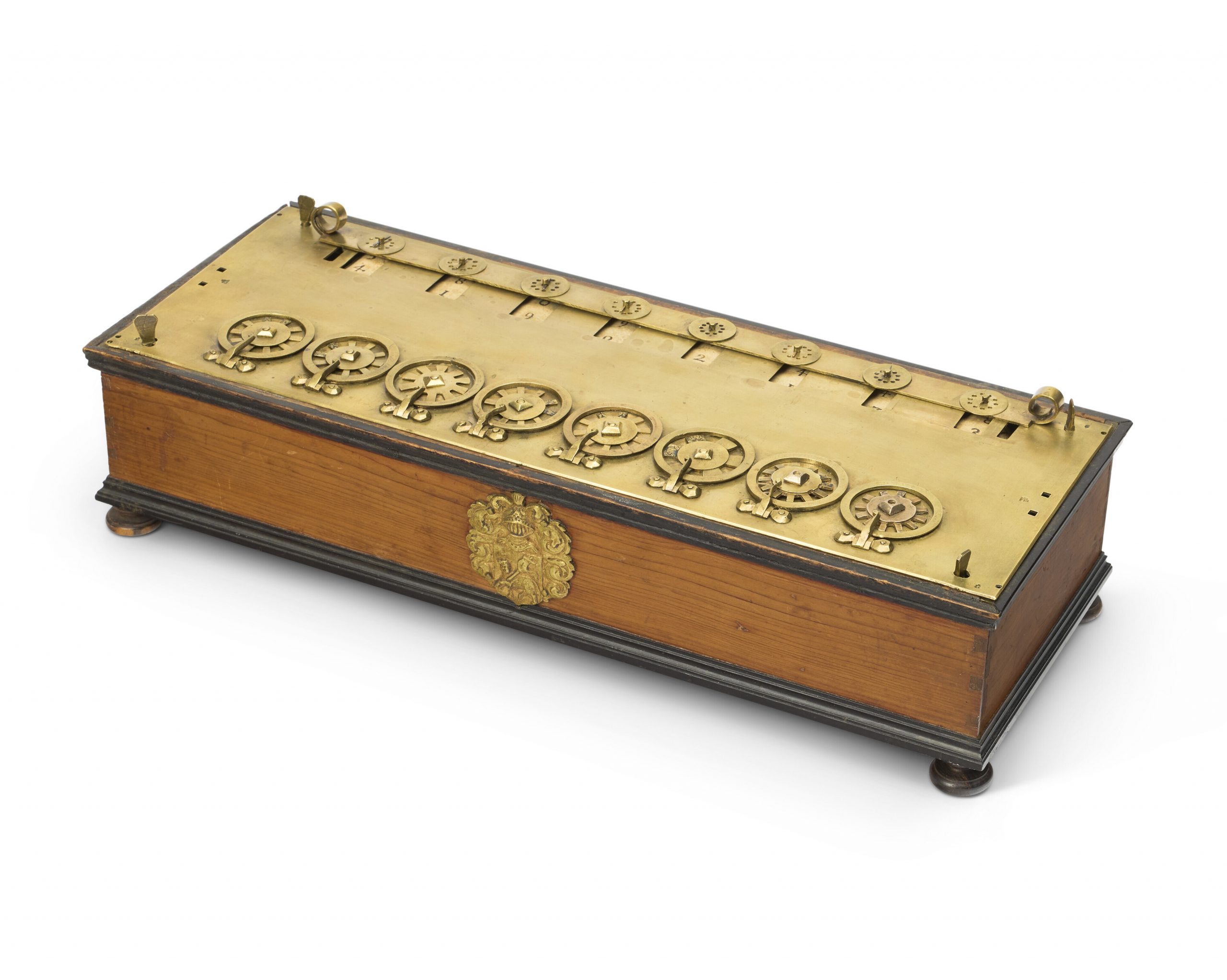
BLAISE PASCAL (1623-1662) – LA PASCALINE Christie’s Images Ltd., Anna Buklovska UPDATE: THE SALE DID NOT GO AHEAD AFTER A PARIS COURT PROVISIONALLY STOPPED THE MACHINE FROM BEING EXPORTED.
Described by Christie’s as the most important scientific instrument ever offered at auction La Pascaline – the first attempt in history to substitute the human mind with a machine – comes up at auction in Paris on November 19 with an estimate of €2 million – €3 million.
Author of a Traité des Sons [treatise on the communication of sounds] at the age of 12, of an essai de géométrie [essay on conic sections] at 16, Blaise Pascal developed the first calculating machine in history at the age of 19. He did so to assist his father, Etienne Pascal, President of the Cour des Aides de Normandie [Board of Excise]. As such, Etienne Pascal was responsible for re-organising the province’s tax revenues – a task requiring countless mathematical operations, accounting calculations and other topographical surveys. To simplify the process, Blaise Pascal designed calculating machines. For the first time in history mental arithmetic had been mechanised. Blaise Pascal designed three types of machines: one for decimal calculations (additions, subtractions, multiplications and divisions), one for accounting (for monetary calculations) and one for surveying (for calculating distances).
Only nine original models of this major scientific and technical revolution remain in existence, and nearly all are held in museums across Europe: These include a model in Clermont-Ferrand, a model in Dresden, a model in Bonn belonging to the IBM collection, and a later version at the Musée des Arts et Métiers in Paris. This is the only one in private hands, the only known model dedicated to survey calculations and this particular 17th century arithmetic machine is still fully functional. It will highlight the the Bibliothèque Léon Parcé sale.