A Fabergé tiara wedding gift from Frederick Francis IV, Grand Duke of Mecklenburg-Schwerin (1882-1945) to his bride Princess Alexandra of Hanover and Cumberland (1882-1963) comes up at Christie’s sale of Magnificent Jewels in Geneva on May 15. The 1904 tiara is of symbolic design with forget-me-not flowers tied with ribbon bows, signifying true and eternal love, pierced by arrows representing cupid. Composed of nine graduated pear-shaped aquamarines, old, cushion and rose-cut diamonds, the historic tiara has a pre-sale estimate of US$ 230,000-340,000.
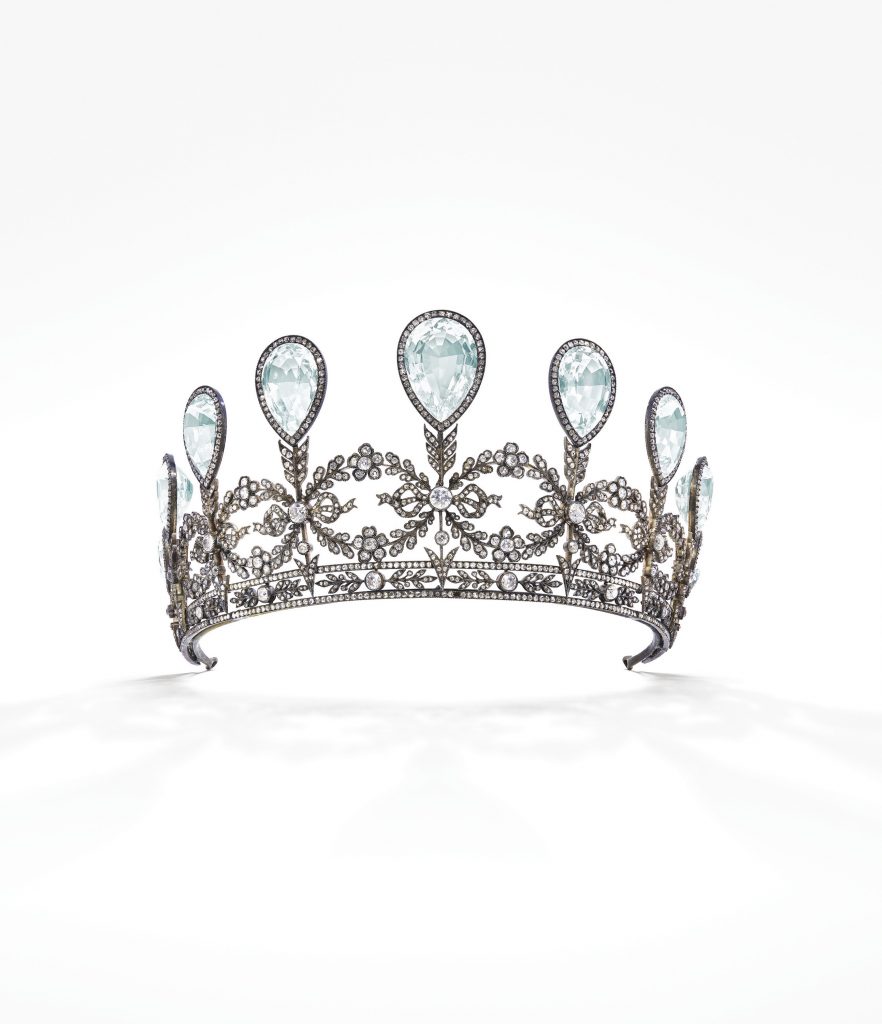

The Grand Duke’s mother, Grand Duchess Anastasia Mikhailovna of Russia, was a keen Fabergé collector, and encouraged him to order his wedding present at the atelier Fabergé in St Petersburg. At the time of their 1904 marriage Frederick was 22 and Alexandra, 21. Archives show correspondence between the Grand Ducal Cabinet of Mecklenburg-Schwerin and Eugène Fabergé, revealing deliberations on a commission of an important jewel. One of the letters dated 10 May discussed the possibilities that could be offered: ‘a diamond tiara’ for 10’000 roubles or ‘an aquamarine and diamond tiara’ for 7’500 roubles, and that only using aquamarines as gemstones was not possible. Another letter referred to drawings with designs Fabergé proposed for the top section of the tiara, sent to the Grand Duchess Anastasia Mikhailovna for her son’s approval. However, these drawings went missing. Fabergé expressed concerns that he held no copies himself and did not know which design appealed to the Grand Duke.
Two weeks before the marriage Fabergé wrote to the Grand Ducal Cabinet that he was yet to receive any instructions to proceed. For a second time he asked for the return of the drawings as he could not advance his work without them. A subsequent letter referred to a completion for the wedding on 7 June, as requested by the Grand Duke by which Fabergé declared that it was impossible to execute the commission in such a short time. On the day of the wedding the Princess wore the traditional Hanoverian nuptial crown commissioned in 1761 for the wedding of King George III of England and Queen Charlotte of Mecklenburg-Strelitz. The Fabergé tiara, her own special wedding gift from the Grand Duke, followed later.


 The conservation of a former tenement house at 14 Henrietta Street in Dublin’s north inner city has been shortlisted for the prestigious European Union Prize for Contemporary Architecture – Mies van der Rohe Award 2019. This is one of 40 projects selected from nearly 400 nominations across Europe. Now a home to Dublin’s social history and open to the public since last September the house at 14 Henrietta Street tells the story of 300 years of city life, all within the walls of one address. Conservation and restoration work at the Dublin City Council-owned building was carried out over a 10-year period.
 The boots worn by Johnny Sexton for the Grand Slam, le Drop and the Champions Cup made a hammer price of 15,500 at
 The magic of Queen Marie-Antoinette held say at